|
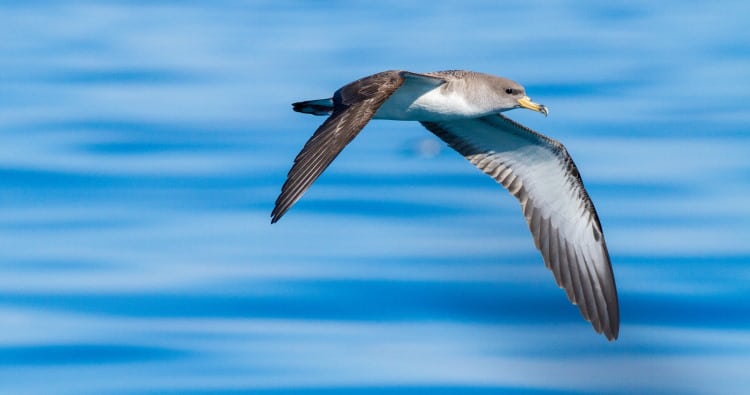
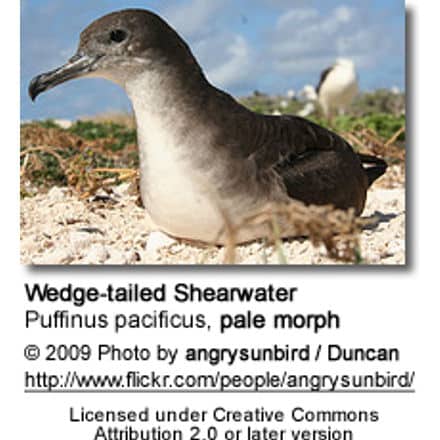
Shearwaters (Procellariidae)
Many Shearwaters undergo impressive migrations, often flying to the opposite side of the world, from the UK to Brazil and back in the case of the Manx Shearwater, or from South Australia and Tasmania to the North Pacific and back (a round trip of some 20 000 miles or 32 000 km) in the case of the Short-tailed Shearwater, Puffinus tenuirostris. Like all petrels they are marine birds which spend their lives on the open ocean except when breeding. They breed in colonies mostly on remote islands and sea cliffs though several species nest inland. They are all communal feeders, aggregating wherever food is plentiful. Most are nocturnal when on land during the breeding season, staying at sea until after sunset.
Shearwaters are normally seen on the water or above it, but they have been recorded diving to 90 cm depth. Like other petrels, Shearwaters collect oil in their stomachs which they derive from the crustaceans in their food. This oil can be used to feed the young. For most species analysed, these oils contain wax esters, triglycerides, fatty acids and vitamins A and D. Shearwaters arrive at the breeding grounds long before they actually start breeding or even courting - Fulmars sometimes arriving before Christmas in the UK for their spring breeding. Courtship in Fulmars involves facing each other and calling, while Shearwaters indulge in complex series of flights over and around the nesting colony, calling in their rather harsh and raucous voices. During this exchange stomach oil may also be exchanged. Though all Shearwaters can eject stomach oil, Fulmars have developed this as a defence mechanism and can spit a stream of foul smelling oil 60-90 cm (2-3 ft) quite accurately. The burrowing Shearwaters and Prions are nocturnal at the breeding site waiting until dark before leaving the relative safety of the sea. Their courtship involves circle flights calling above the burrow entrance. With tens of thousands of birds nesting at one site the noise at a Shearwater colony can be quite freaky at night. This noise combined with thousands of birds flying around in the dark, bumping into things, make the whole site very chaotic from a human point of view.
Incubation takes about 42 to 56 days, depending on the size of the species. The newly hatched bird is not fully homeothermic (i.e. it cannot maintain its own body temperature) so it is brooded constantly by one parent or another for the first week of its life. During this time it is fed regularly on regurgitated stomach oil. Later, as the bird grows this includes partly digested food. After the first week the bird is attended by its parents only at feeding time. Fledging takes about 84 to 140 days in most species, and towards the end of this period the young bird is abandoned. Its weight is often now greater than that of its parents and it starves for 1-2 weeks before it finally takes flight. During this time it loses weight, strengthens its feathers, and also strengthens its wing muscles with flapping exercises. Shearwaters take several years to reach sexual maturity, 7-8 in Fulmarus glacialis. During this time they live mostly at sea though they will return to nesting colonies before they reach maturity and even practice courting. the greatest mortality of Shearwaters occurs while they are in the nest and in the first month or so after fledging, from here on in they experience low mortality. Shearwaters are long lived birds having a potential life span of at least 15 years in most species. Some Shearwaters are eaten by man, or used commercially. Thus Islanders in the Tristan da Cunha Islands take about 15 000 to 20 000 eggs from the nesting colonies of The Great Shearwater (Puffinus gravis) every year. The population here is about 4 million birds however so this crop is sustainable. In Australia both adult and chicks of the Short-tailed Shearwater (Puffinus tenuirostris) or Mutton-birds are taken for food, their down and the oil in their stomachs for many years. Now you can by canned Puffinus tenuirostris under the label 'Tasmanian Squab'
The Prions are a small groups of Petrels which were once known as whale birds, this is because they feed on the same marine plankton that baleen whales feed on and were thus likely to be good indicators of where the whales may be. There are six species with several subspecies which may one day be raised to full species, four of these species are hole nesters and two nest among boulders. They are all very similar in size and colouration with distinctive W like white markings on their wings. The hole nesters have wider bills and special comb-like growths on the palate to help them strain zooplankton out of the water There are in all 9 species of Petrel listed as Critically Endangered and 4 listed as Endangered.
Book ReviewsThe Behaviour, Population Ecology and Physiology of the Petrels, by John Warham
You are visitor number
, was designed and written solely by MrGordonRamel@yahoo.com
|
Other Invertebrates Fish, Amphibians Birds, Mammals Prokaryotes, Lichens Poets For Humanity The Hypertexts The Earthlife Web Actively Promotes modern-day slavery. Please Visit Anti-Slavery International |
|||||||||||||||||||||||||||||||||||||||||||||||