
The ecology of reproduction is often the most diverse and fascinating aspect of studying any group of animals.
The fish – with over 34,000 species – are no exception.
There is a huge amount of data available on the highly complex subject of fish reproduction and I apologize if this page is rather long. I have done my best to keep to simple explanations and a rational presentation.
There are numerous ways to look at the ecology of reproduction in fish. I will start with the basics of males and females getting together and then take a look at what they do once they get together (spawning and aftercare techniques).
Then, finally, I shall talk about egg production.
Gender Disposition: Dioecism, Pathenogenesis, Hermaphrodism
As with all living creatures, reproduction is a crucially important aspect of the life of an adult fish. Nearly all fish follow the standard pattern of reproducing through the union of male and female gametes.
The Amazon Molly (named after the women not the river) Poecilia formosa of Mexico and Texas, is one of the world’s few known species of parthenogenetic fish. Another is the Texas Silverside Menidia clarkhubbsi.
However, even these all-female species still need males. They mate with males of a sister species. The presence of the sperm triggers the development of the eggs, but no genetic material is exchanged. The young fish are perfect copies of their mothers – or natural clones.
So much for the extreme exceptions, the vast majority of fish are ‘Dioecious’ (a species that possesses both males and females in separate bodies). However ‘Hermaphrodism’, the alternative to either dioecism or the unisexuality of parthenogenesis, is more common in fish than many people know.
Checking the records of Fishbase, we find that of the 5,718 species whose reproductive choices are listed, 382 are hermaphrodites in one form or another. This is 6.7% of the total.
Hermaphroditic species can be either simultaneously hermaphroditic or sequentially hermaphroditic. In simultaneously hermaphroditic species, each individual is both male and female at the same time. Although the ripening of the gonads may be sequential, to prevent unnecessary self fertilization.
In sequentially hermaphroditic species, any given individual is only one gender at a time – but it can change its gender when necessary.
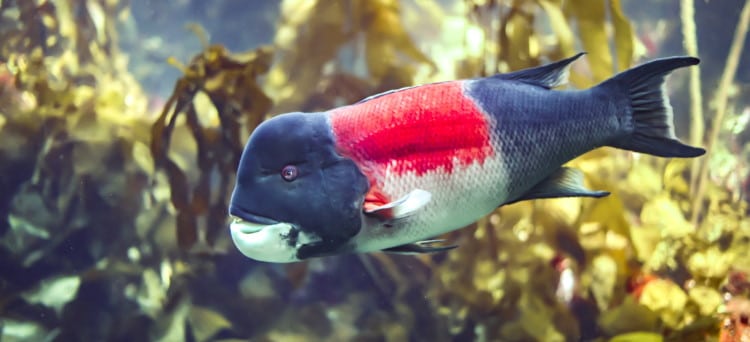
In sequentially hermaphroditic species all individuals are born as the same gender. This can be either male or female, but is fixed for the species. The gender change in fish follows environmental cues that normally reflect the reproductive state of other nearby individuals of the same species.
- Species born male that change to female are Protandrous (andros = male, proto = first).
- Species born female that change to male are Protogynous (gyne = female, proto = first).
For most fish, reproduction means males and females getting together so that their gametes can also get together.
The simplest way of doing this is for a male and a female to be living in the same place, at the same time. Sperm and eggs are then simply released into the water synchronistically (at the same time).
The sperm then have to swim around until they find an egg. The more eggs there are, the more chance of success they have. So it is better if there are lots of males and lots of females all in the same place, at the same time – releasing their gametes together.
This is the usual case for species that spend their lives in large groups (schools). But even these species may aggregate in a certain place in the breeding season. In species that aggregate for spawning purposes, there is no real courtship (see fish courtship)… and males and females obviously have no problem finding each other.
In most species of fish, the females are larger than the males.
This sexual dimorphism is not normally more than a difference of about 10% to 15% percent by length, but it can be more than this. It reaches its extreme in those Anglerfish, such as Photocorynus spiniceps, where the adult male lives as a parasite on the female – permanently attached to her and receiving his nutrients from her.
In this species males seldom exceed 15 cms in length, while females of 100cms in length are not uncommon. Interestingly two common exceptions to this generalisation are Cod and Haddock.
Colour changes in the breeding season are not always limited to the male. In the Three-spined Stickleback (Gasterosteus aculeatus), both males and females undergo colour changes. Including changes to the otherwise silvery-white belly, which in the male changes to bright red and in females changes to pale yellow.
There are several sets of cross referencing categories which can be used to divide fish into reproductively similar groups.
- Dioecism, Pathenogenesis, Hermaphrodism – the latter being either sequential or simultaneous (depending on the disposition and functionality of gender)
- Monogamy, Polygyny, Polyandry, Polygynandry (depending on the mating partnerships)
- External, Internal Fertilization – with the latter occurring in three forms Oviparous, Ovoviviparous and Viviporous (depending on how the eggs are fertilized and nourished)
- Pelagic, Benthic Spawners (depending on where the eggs are deposited after fertilization)
- Bearers, Guarders and Non-guarders (depending on the adults relationship to the eggs after fertilization)
We have discussed category 1 already, so lets look at category 2.
Mating Partnerships: Monogamy, Polygyny, Polyandry, Polygynandry
Monogamy
Monogamy is where one male and one female form a pair bond for life – or at least for one reproductive season. This is rare in fish. Mostly it is seen in many species of Anenome Fish and in those Cichlids where both parents take part in guarding the eggs and young.
Polygyny
Polygyny is a reproductive system based on one male and two or more females.
Commonly, Polygyny occurs when a male forms a harem and actively keeps all other males away from the females that make up his harem. He may attract the females by maintaining possession of a high quality feeding or breeding territory. The females may live with him, or they may simply visit him for reproductive purposes and then leave.
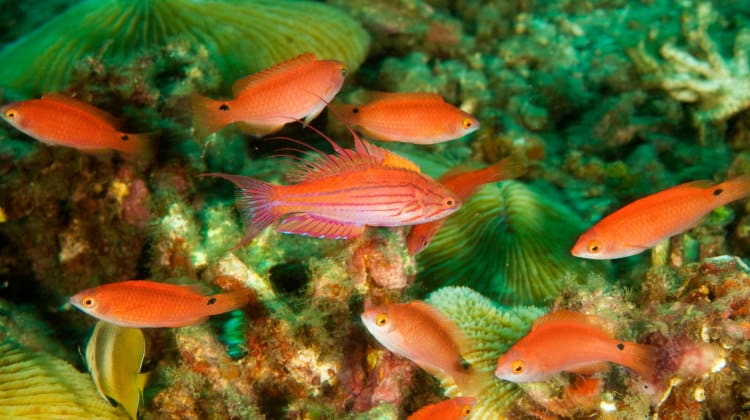
Polygyny can also occur as a result of Lekking.
Lekking is where all the males of an area gather together in a ‘Lek’ to display (birds do it as well). Females visit the Lek, chose a male and leave with him to mate.
As the male returns to the lek after mating, he may well be chosen again and thus lekking often results in Polygyny.
The Cichlid Cyrtocara eucinostomus in Lake Malawi, Africa produces some of the most amazing leks in the world – where as many as 50,000 males gather together in a lek 4km long.
Polyandry
Polyandry is where one female mates with more than one male. It is very rare in fish. It only occurs in a few species of Pipefish where the males brood the eggs and females produce more eggs than a single male can brood. Also in a few species of Anglerfish, where the males are minute and live parasitically on the female; a single female may support several males.
Polygynandrous
For the majority of fish, there is no particular pair bond.
We call them Polygynandrous, but you will find the term ‘Promiscuous’ used as well. A female may have her eggs fertilized by many males and a male may fertilize the eggs of many females.
This is a natural result of the statistics of mass spawning and not a set of moral judgments. It would be wrong to assume the scientific use of the word carried any of the emotional or psychological overtones it has in everyday human life.
Fish Spawning (Pelagic and Benthic)
Mass spawning is the most common method of reproduction in fish.
As in the case of the large schools of fish mentioned above, it involves all the members of a particular species in a particular area getting together in a single place to release sperm and eggs together.
This works for fish because they live in water. The eggs and the sperm can live for a time away from the adults that produced them.
Species that use this method include many of our favourite food species such as Tuna, Sardines (actually several different species of fish), Pilchards, Cod, Mackeral, Pollack, Hake, Tailor, Halibut, Eels, Herring and Menhaden – which we don’t eat but feed to our livestock.
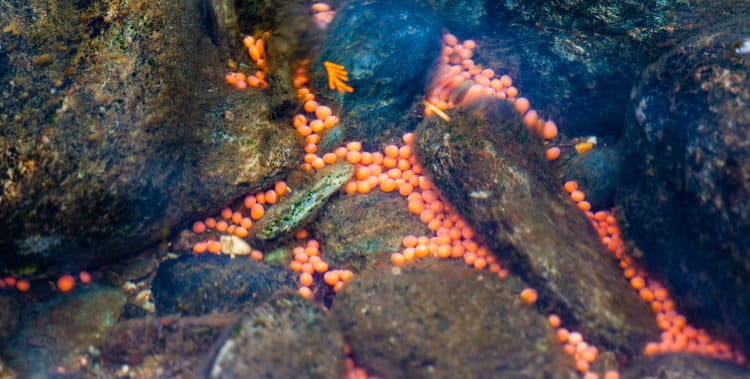
Although this sounds a bit haphazard, it works because of the large numbers that are involved. Fish that spawn like this in open waters often produce eggs by the millions (and sperm by the many-billions – uncountable really).
The table below lists a selection of species and their egg production – including many mass spawners. However the record holding species for egg production is the Greasy Gopher (Epinephalus tauvina) of the Indo-pacific, whose females produce as many as 340,000,000 eggs each season.
Another serious believer in the philosophy that more is better is the Black Marlin (Makaira indica), whose females produce between 67 and 226 million eggs each. Needless to say, lesser numbers of only 1 or 2 million eggs a season are much more common.
While neither of these are schooling species the Greasy Grouper does aggregate in large numbers to spawn and the Black Marlin is simply a very large fish.
Bearers And Guarders
Fish which supply no aftercare for their eggs are referred to as ‘Non-guarders’. The companion categories to non-guarders are guarders and bearers.
As the names imply, guarders are species that guard their eggs to some degree and bearers are those species in which one parent carries the pair’s eggs around with them.
Like all fish, Non-guarders can be Pelagic Spawners. The eggs are released into the open water and after fertilization they float off on the varying currents. In other words, they become part of the zooplankton on which so many others feed.
All the species mentioned above are in this category, as are Shad and some Wrasses. This means you can describe Sardines as Promiscuous, Non-guarders and Pelagic Spawners.
Note that all Promiscuous species are Non-guarders, but not all Non-guarders are Promiscuous. While all Pelagic Spawners are Non-Guarders, but not all Non-guarders are Pelagic Spawners. However one thing all non-guarders have in common is that their reproductive cycle involves very little (or no) courtship.
Type 2 Non-guarders are the Benthic Spawners. In this case the eggs are released and fall to the substrate (the sea floor, etc.), here they are fertilized by the males. But they are not carried away by the currents so easily – many of these eggs are designed to stay put.
They can be sticky and adhere to plants or rocks. Or they can be small and rapidly take on water, trapping themselves in small crevasses. Pike and many species of Carp are Benthic Spawners that choose weedy places in which to spawn.
While most Pelagic Spawners are promiscuous, quite a few Benthic Spawners are not. In such a cases, a male and a female may get together (see below), court and eventually spawn – so that the eggs are all fertilized by the chosen male. Such species may well aggregate to spawn, and many of them actively hide the eggs in rock crevasses, among plants or in the gravel of a river bed, as do both Trout and Salmon.
Type 3 Non-guarders are the Demersal Spawners. The most famous examples of this reproductive method are the Grunion, (Leuresthes tenuis) who all gather together to spawn on a single spring night at high tide, burying their eggs in the sand where they will remain for about 15 days – undisturbed until the next equivalent high tide.
Internal & External Fertilization: Oviparous, Ovoviviparous and Viviparous
Three more important terms in the science of fish reproductive biology are Oviparous, Ovoviviparous and Viviparous.
Oviparous
A species is Oviparous if the eggs are fertilized internally and then laid by the female.
Ovoviviparous
They are Ovoviviparous if the eggs are fertilized internally and then carried in the female’s body until they hatch (then they are born alive, not laid as an egg). Still all the nutrients the young embyro needs are in the egg before it is fertilized.
Viviparous
Finally, a fish species is Viviparous if the eggs are fertilized internally and the embryos kept within the female’s body until they are born alive. But, these embryos receive nutrients directly from the mother while they are developing, in addition to those in the egg at the time of fertilization.
Internal fertilization is possible for fish via modification of the anal fin of the male into a copulatory organ. Viviparity is rare in fish (but common amongst mammals). A very successful example is the common Mosquito fish, Gambusia affinis, which produces about 30 young with a gestation period of 24 days.
However, not every species of fish believes in scattering huge numbers of small eggs across the ocean in the hope that a few of them will survive. Many species choose to produce fewer, but larger, eggs – and may even keep the eggs inside the female’s body until they are ready to hatch.
At the opposite extreme to the Greasy Grouper and the Black Marlin are the four members of the genus Mobula, more commonly known as Devil Rays, i.e. Mobula hypostoma, the Lesser Devil Ray.
Each of these produces only one egg and subsequently only one young per season. These young are born alive and never know the open water as an egg.
Number Of Young In Sharks And Rays
| Common name | Scientific name | # Young |
|---|---|---|
| The Black-spotted Shark | (Carcharhinus sealei) | 1-2 young |
| Bristly Catshark | (Halaelurus hispidus) | 2 young |
| Brown Catshark | (Apristurus brunneus) | 2 young |
| Caribbean Sharpnose Shark | (Rhizoprionodon porosus) | 2-6 young |
However, not all internal fertilizers (live bearers) restrict themselves to only one or two young. Guppies (Poecilia reticulata) give birth to up to 40 young. While the Green Swordtail (Xiphophorus helleri), one of the most prolific of live bearers, can produce as many as 200 young.
If you produce only a few young at a time, then keeping them alive becomes more important. Fish have evolved a diverse selection of strategies to protect their eggs after fertilization.
Apart from live bearing, which was mentioned above, these strategies include a variety of methods of external incubation (not inside the female’s body cavity). As well as many different ways of hiding or protecting the eggs from casual predators, such as building a nest or using the topography of the land under – or even above – the water.
Fish Brooding
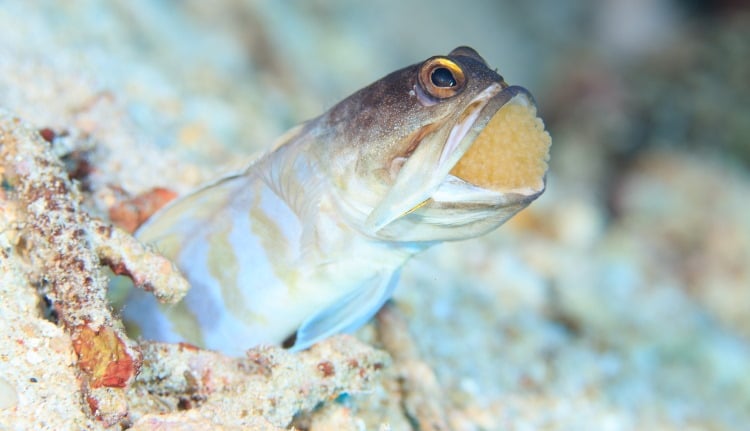
One of the most common and most well know methods is mouth brooding, such as that carried out by Cardinal Fish and many Cichlids. In these cases, one member of a pair collects the eggs in his or her mouth after fertilization and keeps them safe there until they hatch. This can often mean the adult not eating for several days, or even weeks.
A second well known method is external brooding in a pouch, or with the eggs stuck to the male’s body.
This method has the benefit of not requiring the brooding adult fish to fast. Sea Horses and Pipefish are the most famous examples of this method. In most cases it is the male who carries the eggs or who has the pouch, but in the Ghost Pipefish (Solenostomus cyanopterus ) it is the female who has the pouch.
In the most extreme case, Siphostoma typhale, the pouch grows a network of blood vessels which deliver oxygen – and even some nutrients – to the incubating eggs.
A third fascinating method of external brooding used by a few species is gill brooding.
Here, as the name suggests, the eggs are brooded in the gill cavity of the adult. Some fish such as the Clingfish Platystachus cotylephorus manage to brood their eggs without a pouch, by sticking them to the undersides of their own bodies.
Other ways in which fish try to protect their eggs include:
- building a nest (Sticklebacks)
- burying them in sand (Trout Oncorhynchus mykiss and Salmon Salmo salar)
- sticking them to rocks (Cornish Suckerfish Lepadogaster lepadogaster)
- tangling them in plants (Armed Bulheads)
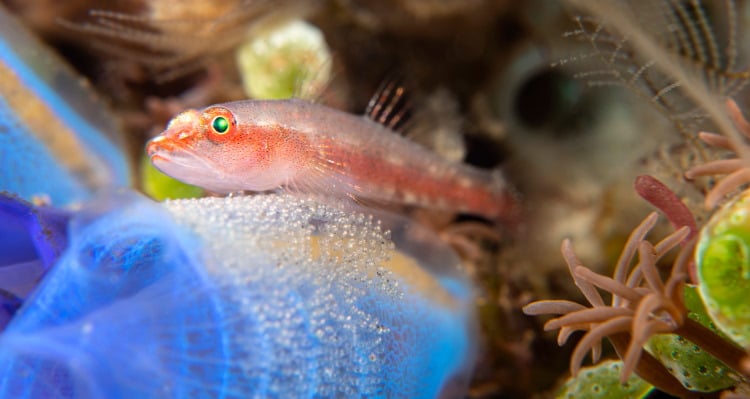
- laying them inside empty shells (Gunnels and some Gobies, Gobiidae)
- or even laying them inside the a living bivalve (such as is the practice of the Bitterling with Swan Mussels)
Fish which brood externally usually produce more young than those which brood internally, even though they produce far less than those who do not brood at all. However, the actual number of eggs brooded is also dependent on the size of the eggs relative to the size of the adult fish.
Fish Egg Sizes
Comparing Fish Length, Egg Diametre And Number Of Fish Eggs Produced
| Scientific name | Common name | Adult length | Egg diametre | Egg number |
|---|---|---|---|---|
| Hippocampus zosterae | Dwarf Seahorse | 5 cm | 1.3 mm | 455 |
| Melanochromus auratus | Golden mbuna | 10 cm | 2.9 mm | 40 |
| Hippocampus capensis | Knysna seahorse | 12 cm | 95 | |
| Limnochromis auritus | Spangled Cichlid | 13 cm | 300 | |
| Vincentia conspersus | Australian Cardinal | 14 cm | 4.0 mm | 150 |
| Haplochromis burtoni | Burton’s Haplo | 15 cm | 2.7 mm | 35 |
| Apogon imberbis | Cardinal Fish | 15 cm | 0.5 mm | 20000 |
| Geophagus surinamensis | Red-striped Earth Eater | 30 cm | 250 | |
| Hippocampus kuda | Spotted Seahorse | 30 cm | 1.8 mm | 750 |
| Galeichthys felis | Hardhead sea catfish | 70 cm | 20.0 mm | 50 |
Many factors combine to control the number of eggs a female fish can produce. As fish keep on growing older and therefore larger, females tend to produce more eggs than younger ones.
A female Atlantic Cod (Gadus morhua) weighing 5 kg will produce about 2,500,000 eggs, while one weighing 34 kg will produce about 9,000,000. However, absolute size is not always the final word.
In the Common Carp (see below) egg production reaches a peak at around 55 cm. After this, at both 60 cm (not in chart) and at 65 cm, egg production stabilizes at a level slightly below the peak.
Relationship between number of fish eggs produced and fish size
| Female body length in mm | 35 mm | 45 mm | 55 mm | 65 mm | 75 mm | 85 mm | 95 mm |
|---|---|---|---|---|---|---|---|
| Common Carp (Carausius carpio) | 181000 | 375000 | 550000 | 525000 | |||
| Pike Perch (Lucioperca lucioperca) | 203000 | 331000 | 487000 | 685000 | 851000 | ||
| Atlantic Salmon (Salmo salar) | 5900 | 9400 | 12200 | 14000 | 19400 |
When reading the table below, you should note that these figures are averages based on dissections of mature females.
You should also note that the number of fish eggs a female of any species can produce is not only related to her size (and the relative size of her eggs) but to her health and her nutritional status. If for some reason her food intake is less than optimum, or if she is ill because of disease or pollution, she will produce a less-than-optimum number of eggs.
Average number of fish eggs found in the ovaries of mature females
| Common Name | Scientific Name | Number of Eggs |
|---|---|---|
| Great White Shark | Carcharodon carcharias | 7 |
| Nurse Shark | Ginglymostoma cirratum | 25 |
| Blonde Ray | Raja brachyura | 40 |
| Bitterling (Amur) | Rhodeus sericeus | 100 |
| Nile Tilapia | Oreochromis niloticus | 200 |
| Marbled Lungfish | Protopterus aethiopicus aethiopicus | 460 |
| Chocolate Clownfish | Amphiprion clarkii | 1000 |
| Large-mouth Bass | Micropterus salmoides | 2000 |
| Chinook Salmon | Oncorhyncus tohawytscha | 4000 |
| Orange Roughy | Hoplostethus atlanticus | 10000 |
| European Perch | Perca fluviatilis | 15000 |
| Atlantic Herring | Clupea harengus harengus | 20000 |
| Atlantic Menhaden | Brevoortia tyrannus | 38000 |
| Tiger-toothed Croaker | Otolithes ruber | 53500 |
| Flathead Sole | Hippoglossoides elassodon | 72000 |
| Haddock | Melanogrammus aeglefinus | 100000 |
| Pollock | Pollachius virens | 220000 |
| Arctic Toothfish | Dissostichus mawsoni | 400000 |
| Guianan Snook | Centropomus mexicanus | 800000 |
| Tarpon | Megalops atlanticus | 1000000 |
| European Hake | Merluccius merluccius | 2000000 |
| American Eel | Anguilla rostrata | 5000000 |
| Southern Bluefin Tuna | Thunnus maccoyii | 14000000 |
| Ling | Molva molva | 60000000 |
| Ocean Sunfish | Mola mola | 300000000 |
What Next?
Well, I hope this has been an interesting look into the world of fish reproduction.
Finally, it should be noted that many species of fish continue to care for and protect their young even after they have hatched. This is particularly evident in Cichlid mouth brooders, who allow their young hatchlings to return to the comparative safety of the parent’s mouth for some time.
In the extreme case of the Atlantic Plunderfish, Harpagifer bispinis, adult guarding of the young may continue for four months.
Perhaps now you’d like to know more about genetically modified fish or fish conservation.
You can also check out more information on the eggs and egg-capsules of Sharks, Skates and Rays. Or for an identification guide to the egg capsules of some European Skates see The Great Egg Case Hunt



Hello. I am trying to find out about trumpetfish in the tropical western atlantic. I get conflicting information. do the females release eggs that are then internally brooded by the male like a seahorse ? or do they broadcast spawn and the eggs are externally fertilized and then sent adrift ?
To the best of my knowledge they are male brooders like the Seahorses they are related too.