Ants are among the most amazing and fascinating creatures in the world. They are all social and live in large groups of mostly sterile sisters who work to raise the sexual offspring of their mother the Queen. The fact that ants live in communities, make gardens, keep farm animals, fight wars and enslave other ants has fascinated mankind for as long as we have observed them. There are a lot of books written on ants and I hope that what you read here will wet your appetite to learn more about these delightful and complex creatures.
There are 12,400 known species of ants in the world today and they have a wide variety of lifestyles. For instance the giant Australian Bull Ants which can be over 2.5 cms long, live very simple lives and the Queens and Workers look very similar. In contrast the Leaf cutting ants of Central and South America have a much more complicated social structure in their nests. There can be 3 or 4 different sizes of workers as well as large soldiers, males and Giant Queens and Gynes (a gyne is an unmated female sexual, she is called a Queen after she has mated).
The oldest known ant in the world was found preserved in amber and lived 100 million years ago in the Mid-Cretaceous period. It is called Sphecomyrma freyi.
Though some ant species live in extremely large nests and colonies can contain amazing numbers of ants such as the single supercolony of Formica yessensis on the Coast of Japan which is reported to have had an incredible 1 080 000 queens and 306 000 000 workers in 45 interconnected nests, others can be very small. Nests of Leptothorax tuberointeruptus on the British coast can consist of only one queen and 50 workers and be so small they can exist in a space equivalent to 2 one pence pieces held apart by a few grains of sand.
Ants are amazingly successful creatures, on the Ivory Coast in Africa there can be as many as 7 000 colonies of ants per hectare, with an average of around 2 850 ants per colony this adds up 20 000 000 ants per hectare or 2 000 per square metre. Some scientists have estimated that if you weighed up all the animals in the Amazon Basin ants would make up about 30% of the total, and though they are not this successful everywhere it is considered that they might make up as much as 10% of the total animal biomass of the world.
Ants As Pests
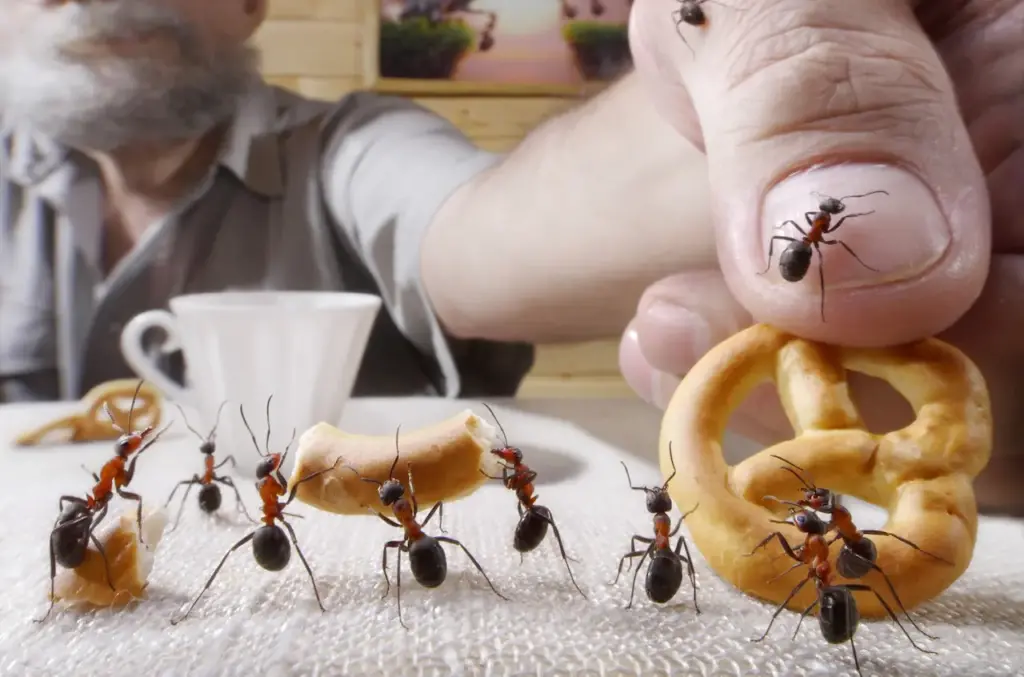
Ants are among the most fascinating animals around to study, in particular I am always amazed at their brilliant ability to recruit workers to a source of food, as well as their ability to find new and temporary food sources. I have lived in Tropical environments and am currently living in the Mediterranean where over 360 species of ants thrive. While I can’t help admiring the speed with which they find any spilt sugar or fat I do not enjoy sharing my house with them. It is a fact of life that ants can become serious pests, in fact, in some parts of the world, sugar is hardly ever sugar without ants, and while local species can be a serious problem, introduced species can often be an even bigger one. They live very well in our buildings, both old fashioned like the adobe house I had in Greece and in modern cement and steel apartment blocks. ‘Ant Control’ is a scientific endeavour these days, and it is well worth checking out what the experts have made available before trying whatever your local supermarket has on the shelf.
Why do Ants live in Colonies
There is no simple answer to this question which eventually leads you to a study of the whole of ecology. Though generally we assume that it is because living this way allows the ants to compete more successfully with other animals, considering their success as animals it is obviously works as a strategy for them. A different question might be why don’t more animals live in colonies? Part of the answer to this is that most insects are not carnivores and generally speaking it is more efficient for small herbivores to feed on their food where it is rather than bring it back to a central nest.
Ant Ecology
Because different species of ants live such diverse lives it is not possible to describe an average lifestyle, instead what follows is a brief description of the lifecycle of Lasius niger known in Britain as the Common Black Ant or the Pavement Ant (not to be confused with Tetramorium caespitum the Pavement Ant of the rest of Europe, a good example of why we have Latin names). And then a few facts about some of the most fascinating ants of all The Leaf Cutters of South America.
Black Garden Ant (Lasius niger)
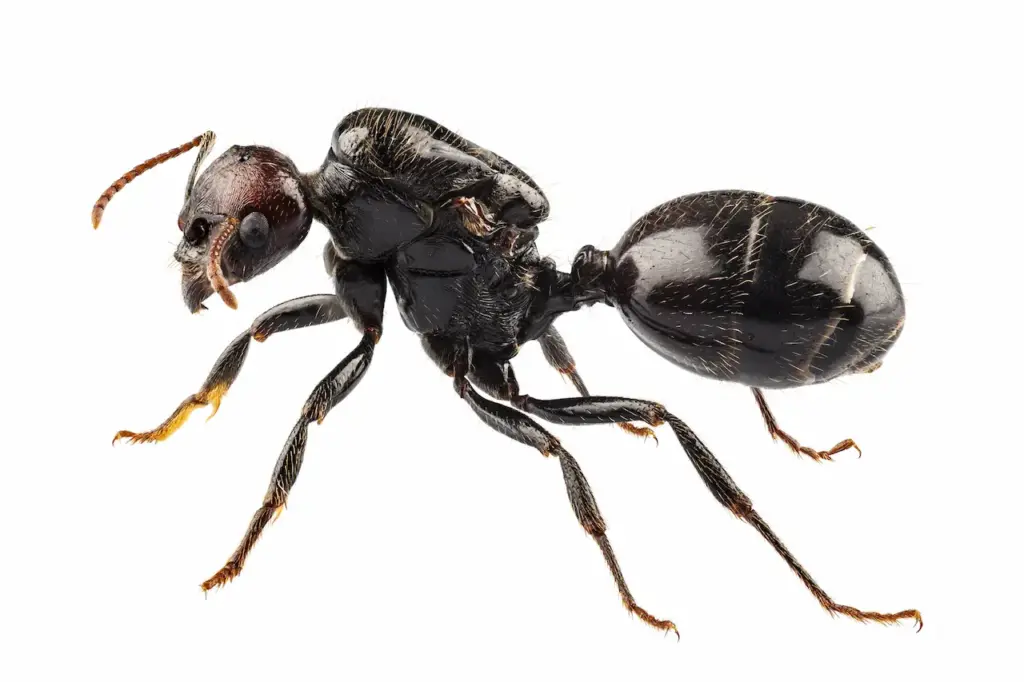
For much of the year most of the ants in the nest are the neuter (sexless) females known as workers. They are all sisters and generally speaking have no young of their own. Instead they help raise more younger sisters which have been produced by the mutual mother the Queen. Sometime in late June or early July however the Queen lays some special eggs, these grow up to be the new sexuals, both females (called gynes) and males. Unlike other ants these sexuals can fly, on some warm evening the sexuals from all the nests in a given area (this can be an area as large as Southern England for L. niger) rise up from their underground nest and go in search of mates from other nests. Most species of ants do this at some time of year and it is known as the ‘Nuptial Flight’. The males compete for the females and the females may mate with more than one male during the nuptial flight but they never mate again after it. You can often spot when a nuptial flight is happening because loads of birds have an aerial feast on the fat rich sexuals, sexuals are larger than the workers and often easy to catch.
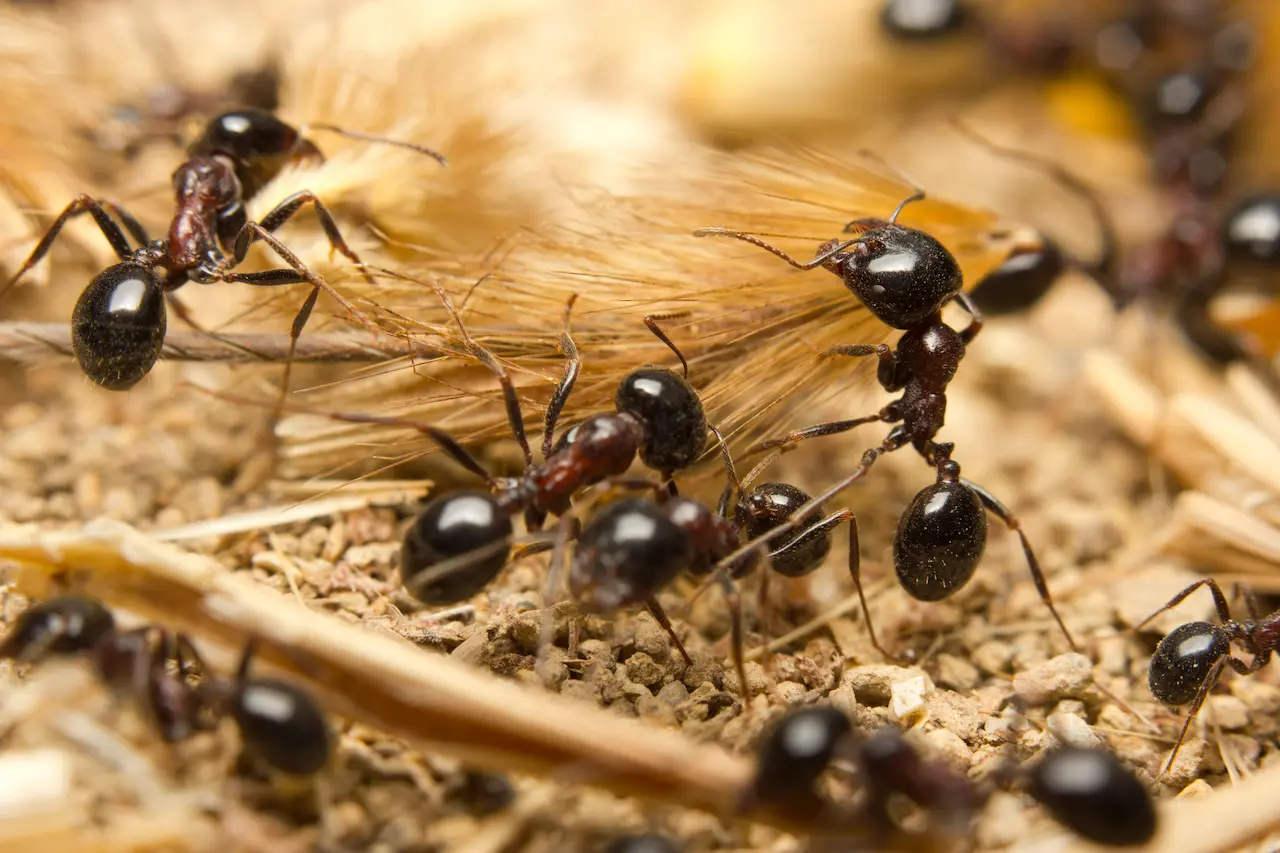
Once she is mated, a female ant is called a Queen, she is destined to be the longest lived and most important member of a new colony (some wood-ant queens are known to live for more than 20 years). The first act of the newly mated queen is to find a safe place to make a new home. Once she has found a suitable site, generally under a log or stone, she digs and scrapes a small hole, climbs into it then plugs up the entrance from the inside so that she is well hidden from the world (this is considered to be an advanced trait in ants as many species are not so isolationist).
After (or some times before) secreting herself away the new queen discards her wings, she will never fly again and they are nutritionally valueless, and redigests her large thoracic flight muscles as these have served their single purpose in life and are now more use as a food reserve for the next few months, during this time she will raise her first brood of workers without eating a single meal.
She is ready to lay eggs in 4 to 7 days and her first lot of eggs, about 10 to 20 in number hatch into very small workers called ‘nanitics’. These nanitics take over the job of raising the queens young and they will soon be helped by the next lot of full sized workers. The queen now settles down to a life of eating and laying eggs.
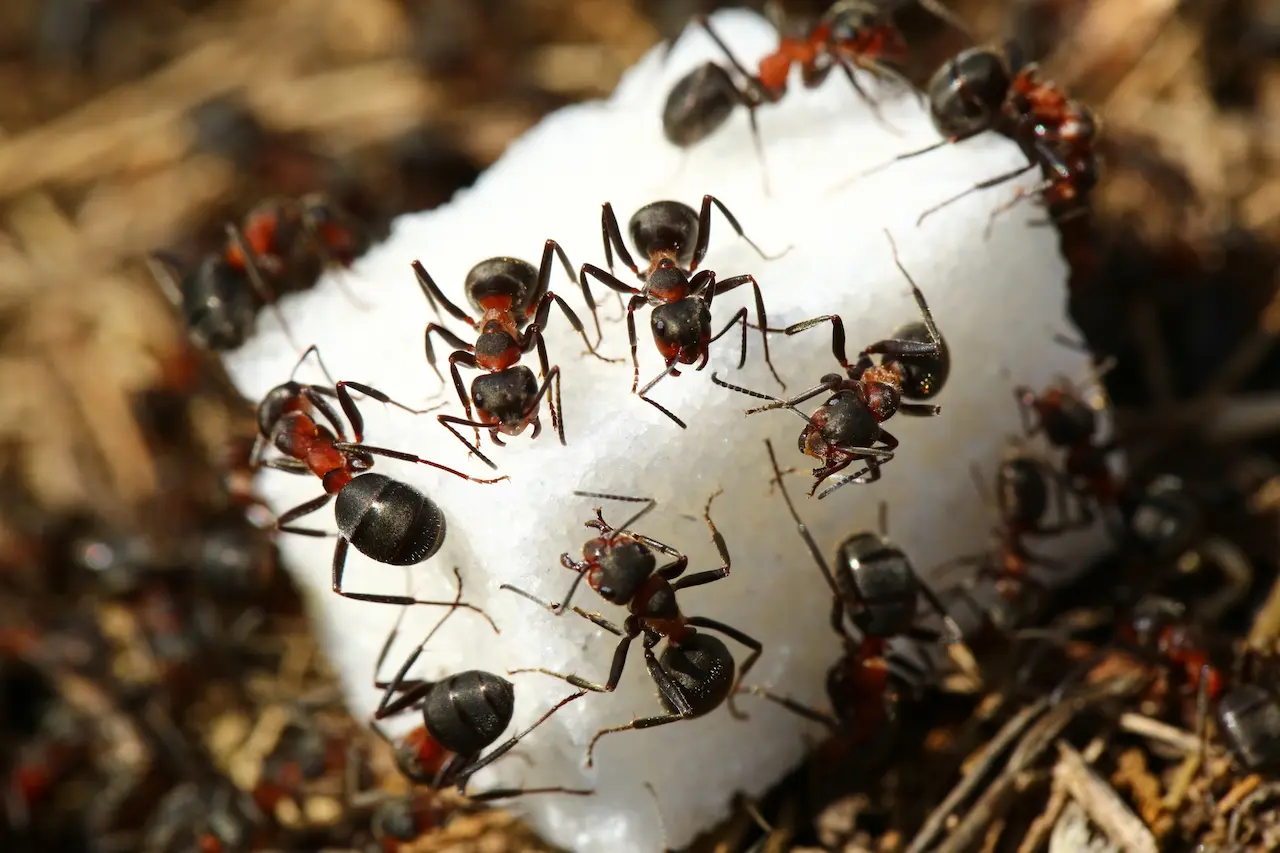
The nanitics open the entrance to the nest and start foraging for food as soon as the weather is suitable. Foragers collect nectar from flowers and a sugary substance called honey-dew from aphids (hemipterans) and some lepidopteran larvae. Different species of ants protect their ‘herd’ and sometimes even build them shelters, these are what is commonly referred to as “ant cattle”.
They also collect seeds and other invertebrates, this solid food is only for the larvae as the adults only need carbohydrates for energy and thus feed exclusively on sugars and water. Ants which have collected some nectar can carry more than they need for themselves in their crops and this extra can be shared with other members of the colony when they get back to the nest. This sharing is done when one ant passes a drop of fluid from its crop into its mouth and a second ant collects it in her mouth This is called ‘trophallaxis’ and looks to us like two ants kissing, it is as important to the ants as kissing is to us, if not more so.
The jobs that ants perform for the colony change during their lives. Newly ‘eclosed’ (having just emerged from the pupa) adult workers, called ‘callows’ work inside the nest as cleaners first , then as nurses helping tend the larvae, then only when they are older do they become foragers and soldiers. Ants are not born with an inherent knowledge of all the work they have to do, but learn by copying their older nest mates. After a few years the colony will be strong enough to start producing sexuals of its own.
The Leaf Cutters
Some of the most amazing and fascinating ants in the world are the South American Attines, there are 202 known species of Attines and all are fungus culturers or gardeners, with the more advanced genera cutting leaves from living plants in order to feed their fungus gardens, hence their vernacular or common names of ‘Leaf Cutters’ or ‘Fungus Gardeners’.
The different Attine species grow a variety of fungi on various substrates and feed themselves and their larva exclusively on the products of the fungi. They can be divided into three different groups depending on the kind of substrate they use and on the degree of polymorphism (having many forms) exhibited by the workers. According to Bug Guide, this species is well documented.
Primitive forms such as Cyphomyrmex remosa are monomorphic (i.e. the workers are all the same basic size) and they use insect droppings and pieces of dead plant material as the substrate for their gardens. Their nests are small with only a few hundred workers who clean the floor area of the nest with their tongues before building a garden on it. They culture a yeast like fungus and feed on the bromatia. According to iNaturalist, this species is well documented.
Transitional forms are exemplified by species of Trachymyrmex, they build larger nests and use fallen flowers and fruit as well as insect frass (droppings specifically insect ones) to feed their gardens, though they are still basically monomorphic.
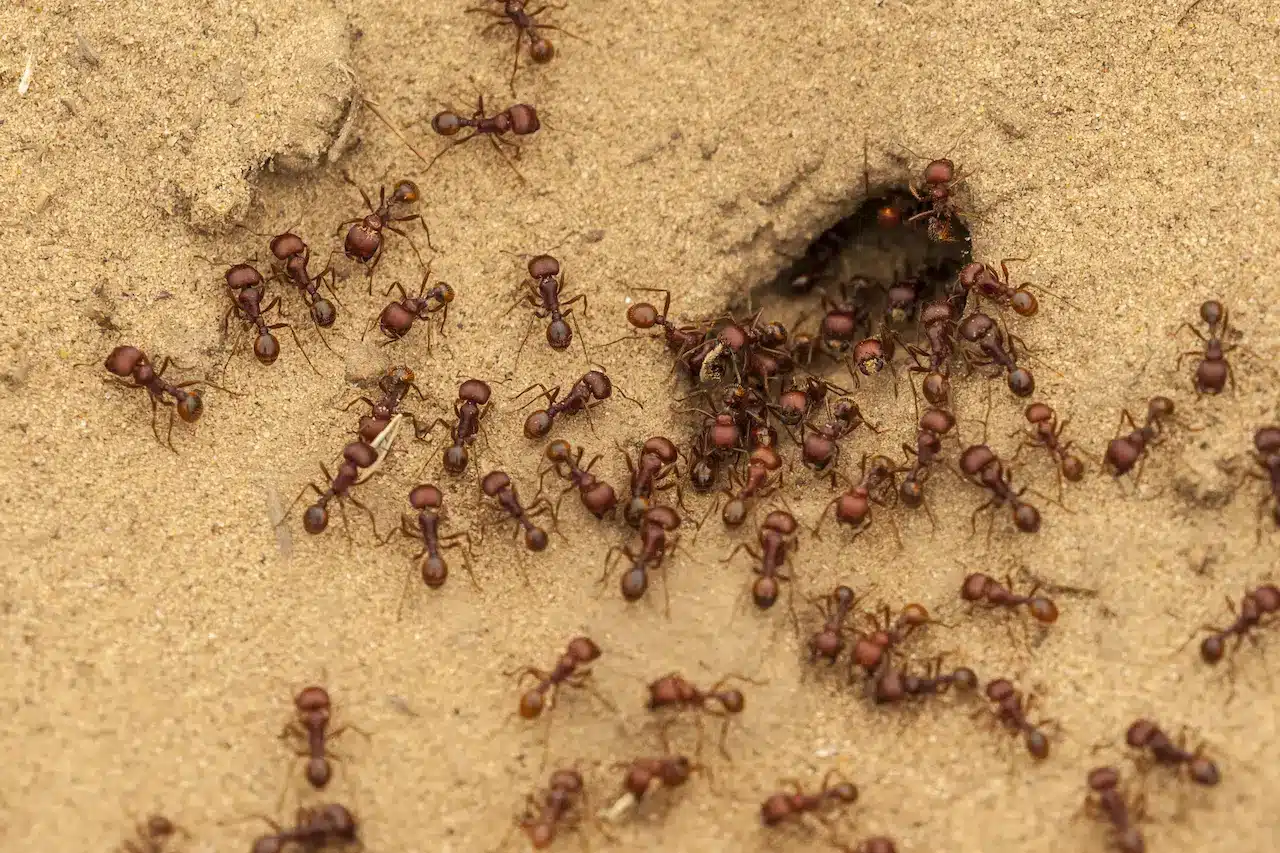
The more advanced types, though they may use dead vegetation to get the first garden in a new colony going, all use fresh cut vegetation after that. They go to far greater efforts to ensure a mono-culture of their desired fungus than the less evolved species. They all have polymorphic workers and the nests of some species can contain well over 500 000 workers.
The construction of a fungus garden begins with the swabbing clean of the floor where it is going to be. Then the first plant material is brought in and cut into little pieces by the media workers. Each piece of leaf is licked clean over its entire surface by the minima and media workers, this helps remove fungal spores, antibiotics such as myrmacacin are released by the ants mandidbular glands help ensure that endophytic (inside the leaf) fungi do not compete with the ants cultured fungi. Next the leaf is built into the garden, which is sculptured to contain many furrows and cavities where the brood is kept. Once in place the leaf piece is fertilised by an anal secretion of the ant which contains some proteases (protein degrading enzymes) which the fungus lacks and then inoculated with several pieces of mycelium (the long thin bits of the fungi which you normally do not see because they are under the ground in macro fungi). Most of this finer worker is done by the minima workers which are the smallest the three or four sizes of workers you can find in most Leaf-Cutter nests.
For genera such as Atta and Acromyrmex and individual garden will be about 10-12 cms in diametre and have a life span of 3 to 4 weeks and it will produce gongylidia on which the ants and their larvae feed. During this time it is scrupulously cared for by the workers and any foreign fungi which develop are carefully removed and thrown out of the nest or on to a garbage dump. A nest will contain many gardens in various stages of use and may be quite large. A large nest can reach several metres (up to about 6) down into the ground and contain dozens of individual gardens. Different species of ant tend to use different plants as substrate, i.e. Atta texana uses grasses where Atta cephalotes uses the leaves of trees.
The fungus used by these higher species, is believed to be Attamyces bromafiticus it is completely dependant on the ants for its propagation and the ants are completely dependant on the fungus for their food. Such is the extent of this amazing mutualism that the fungus has never been found outside of an Attine nest and the gynes all take a small sample of the fungus with them in a special pouch under there chin (called a buccal cavity) when they go on there nuptial flight so that they will be able to start new gardens after they are mated.
There is much more of interest to these ants that I haven’t have time to put here like the fact that they have special soldiers that are larger than all the workers but which don’t seem to do much, or the fact that a lot of workers that go out foraging take a hitching minima worker with them that rides back on the piece of leaf they bring back to the nest with them. I would recommend to anybody to have a closer look at these amazing creatures.
A Final Note
It is important to realise that this is only a generalised view of two groups of ant, all of the variations you can think of on these themes are practiced by some species of ant somewhere. From ants whose queens only produce sexuals. These sexuals mate with each other in their home nest, the females, now queens leave the nest and find a colony of a different but particular species of ant. On finding a suitable nest she enters it, kills the ruling queen and uses her workers to raise her own sexuals, she produces no workers of her own, this is called ‘social parasitism’ the only British example is Anergates atratulus which is a social parasite on Tetramorium caespitum. To ants such as the South American Army ants which have no permanent nest sites, but travel around the forest eating anything they can get their mandibles on and making temporary bivouacs out of their workers bodies whenever the make a short rest at any particular site, i.e. Eciton sp.
A sonnet by G. Ramel 2007
Who can believe the ants, they work so hard,
they build good homes, tend herds and fill their stores,
they grow their gardens and they fight their wars;
some labour long, some rule while some stand guard.
They take no care for God, live as they must,
and we are so like them I hear men say.
They are poor men who live in such a way
taking no time to challenge what they trust.
What then of hearts and minds, what then of brains?
What then of beauty, art and searching thought?
Is all that is not labour judged as nought?
And what of love and all that love explains?
An ant learns well but questions not one task,
a man learns more the more he learns to ask.
Book Reviews
Amy Ants – The Biology of Social Predation, by William H. Gotwald, Jr.
Social Evolution in Ants, by Andrew F. G. Bourke and Nigel R. Franks
Naturalists’ Handbook Vol. 24 ants by G.J.Skinner and G.W. Allen (Very UK oriented)
The Behavioural Ecology of Ants, by John H. Sudd and Nigel R. Franks (Distributed by Chapman and Hall in the US of A)
Picture Parade
Plate 1 :- Showing a selection of British Ants.
Ants on the Internet
BWARS The UK Bees Ants and Wasps Recording Scheme.
AntBase.org Loads of Ant Information
AntWeb An excellent ant site.
Some Beautiful Ant Photographs
Carpenter ants
Japanese Ants An Ant Wiki
Ants of Australia
Ants of India About ant diversity.
The Ants of Egypt
Ants in Lawns
Acrobat Ant
Carpenter Ants In the House
Field Ant Iowa USA
Grease Ants
Odorous House Ant
Pavement Ant Note that this name applies to a different ant species in the USA (where this article comes from) than it does in either the UK or mainland Europe.
Bibliography
Beattie, A. J., (1985). The evolutionary ecology of ant-plant mutualisms. Cambridge University Press,. Cambridge, New York, Sydney etc. Bourke, A.F.G. and Franks, N.F. (1995). Social Evolution in Ants, Princeton Uni Press
Brian
Donisthorpe, H. (1927). The Guests of British Ants. Routledge, London.
Donisthorpe, H.The British Ants
Forel, A., (1928). The Social World of Ants compared with that of Man 2 vols.,
Gotwald Jr, William H.(1995). Army Ants: The Biology of Social Predation, Comstock; Cornell.
Herman H.R. (Ed.) (1981) Social Insects. 2Vols New York
Huxley, J. (1930). Ants. Chatto and Windus, London.
Lubbock, J. (1882). Ants, Bees and Wasps. Kegan Paul, Trench and Co., London.
LaSalle, J. and Gauld, I.D. (1993) Hymenoptera and Biodiversity, CAB International
Maeterlinck, M. (1930). The Life of the Ant, Cassel and Co. Ltd., London, Toronto, Sydney etc.
Morley-Wragge, D.
Skaife. S. H. (1961). The Study of Ants. Longmans, London.
Skinner, G.J. and Allen G.W. (1996) Ants (of the UK), Richmond, UK.
Sudd, J. H. & Franks N. R. (1987). The Behavioural Ecology of Ants, Blackie (USA: Chapman and Hall)
Sudd, J. H. (1967). An Introduction to the Behaviour of Ants, Edward Arnold, London.
Wheeler, W.M., (1910). Ants. Columbia University Press, New York.
Wilson, E. O., (1971). The Insect Societies. Belknap Press of Harvard University Press, Cambridge, Massachusetts, and London.