Etymology: From the Greek Gnathos for jaw, and stoma for mouth.
Characteristics of Gnathostomulida:
- Bilaterally symmetrical, and vermiform.
- Body has more than two cell layers, tissues and organs.
- Body contains no internal cavity.
- Body possesses a blind ending gut, i.e. no anus.
- Possesses simple protonephridia.
- Has a diffuse epidermal nervous system.
- Has a muscular pharynx with paired jaws and a basal plate.
- Reproduction sexual, most if not all species hermaphroditic.
- Feed on bacteria, fungi and protists.
- All live in marine environments.
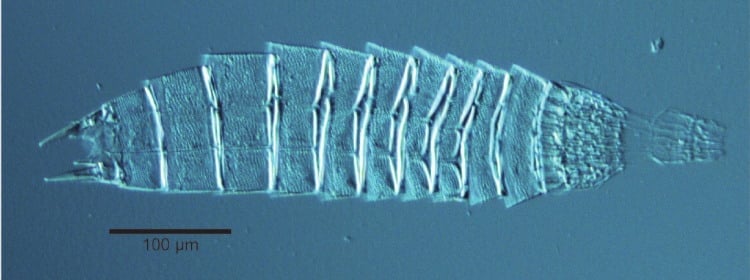
The Gnathostomulida (Sand worms, or Jaw worms) are a small phylum of small marine worms.
Most of the 80 species known to science are between 0.3 and 1.0 mm long. Though they can be extremely common in marine sediments (as many as 600,000 per cubic metre have been counted), they were only first described to science in 1956.
This is because they tend to cling tightly to grains of sand and because they are easily killed in attempting to remove them from the sand grains. Their bodies also break up very quickly after death. All this has made studying them quite difficult and not an awful lot is known about them.
They have a ciliated body surface and can either swim by flexing their whole body, or move across surfaces by ciliary beating.
They are very basic, acoelomate animals with a blind-ending gut (they have a mouth, but no anus), two simple protonephridia and no circulatory or gaseous exchange organs. They feed on bacteria, protists and fungi that they find while moving through the marine sediments they live in.
Gnathostomulids are hermaphroditic with only a single ovary. In some species at least, sperm are injected straight through the body wall – though others have a vagina. The large eggs develop one at a time and fertilisation is internal, sperm being stored in special sac called a ‘bursa’ until needed.
The eggs leave the body by bursting out through the adult’s body wall. Healing of the adult is quick and there is no larval stage, the egg hatching directly into a small but adult gnathostomulid. Individuals go through one or more feeding but non-reproductive stages, followed by a non-feeding but reproductive stage in their lives.
In some species at least, it may take a year to complete a life cycle.
Image license: Creative commons