
Pentastomida (The Tongue Worm Parasites)
Pentastomida – Etymology: From the Greek Pente for five and Stoma for mouth.
Characteristics of the Pentastomida:
- Bilaterally symmetrical and vermiform.

- Body has more than two cell layers, tissues and organs.
- Body cavity a pseudocoelom.
- Most possesses a through straight gut with an anus.
- Body monomeric.
- Nervous system includes a brain and a ventral nerve chord.
- Possesses no circulatory or respiratory system.
- Possesses no excretory organs.
- Reproduction normally sexual and gonochoristic.
- All are parasitic on vertebrates.
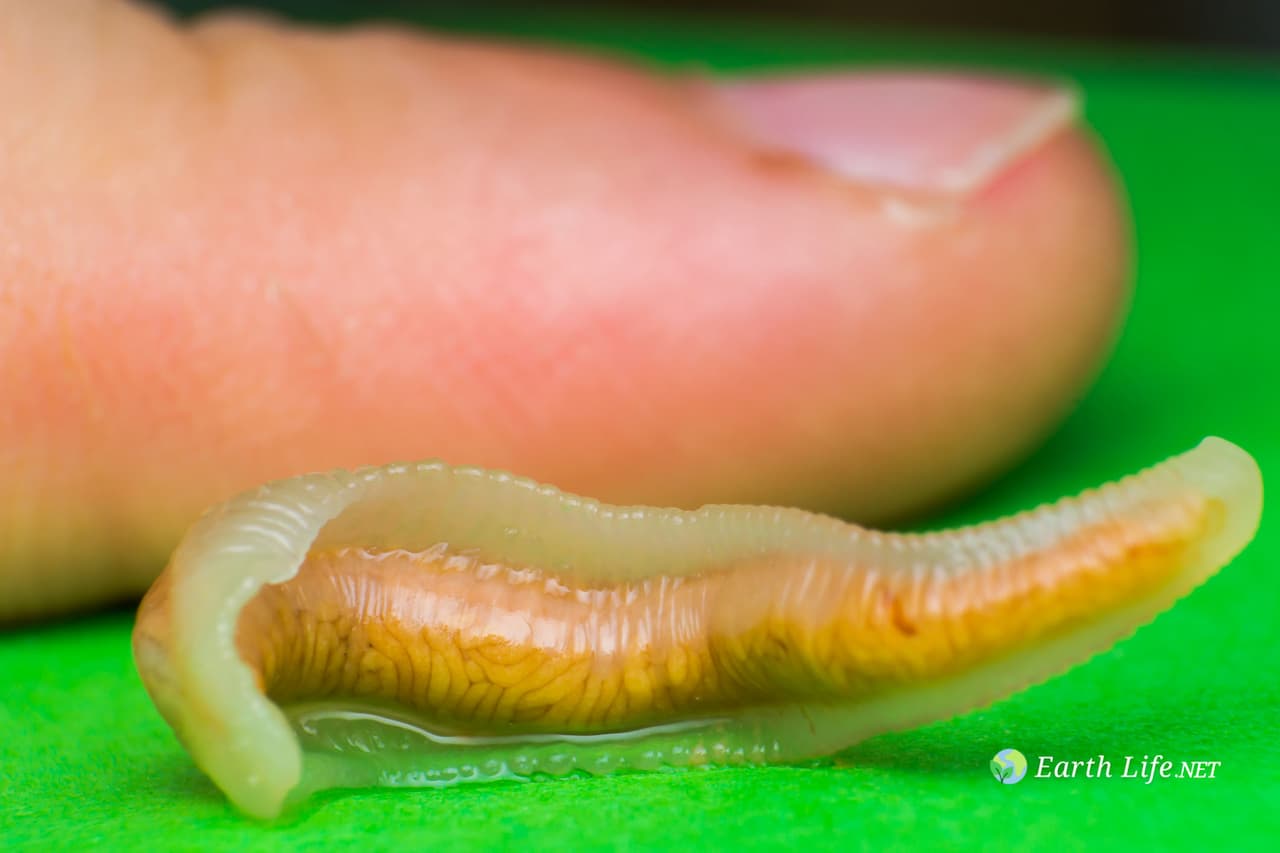
The Pentastomida, or Pentastoma, are a small group of crustacean parasites. While over 130 species are known to science, the concept of a single group of organisms united under the term Pentastomida is now seriously challenged by modern phylogenetic analysis. While there remains debate over the actual affinities of all the species concerned there is general agreement that what was the Pentastomida are no longer a phylum, or even a subphylum.
There is general agreement that all the species that were known as the Pentastomida are really Crustaceans, members of the Phylum Arthropoda. Most experts now put them in the taxon Maxillipoda, but there the agreement ends. Catalogue of Life lists Maxillipoda as a class and has the species distributed through a number of orders within that.
Martin and Davis 2001 list Pentastomida as a subclass of Maxillipoda with four orders within it containing the extant species.
Basic Biology of the Pentastomida
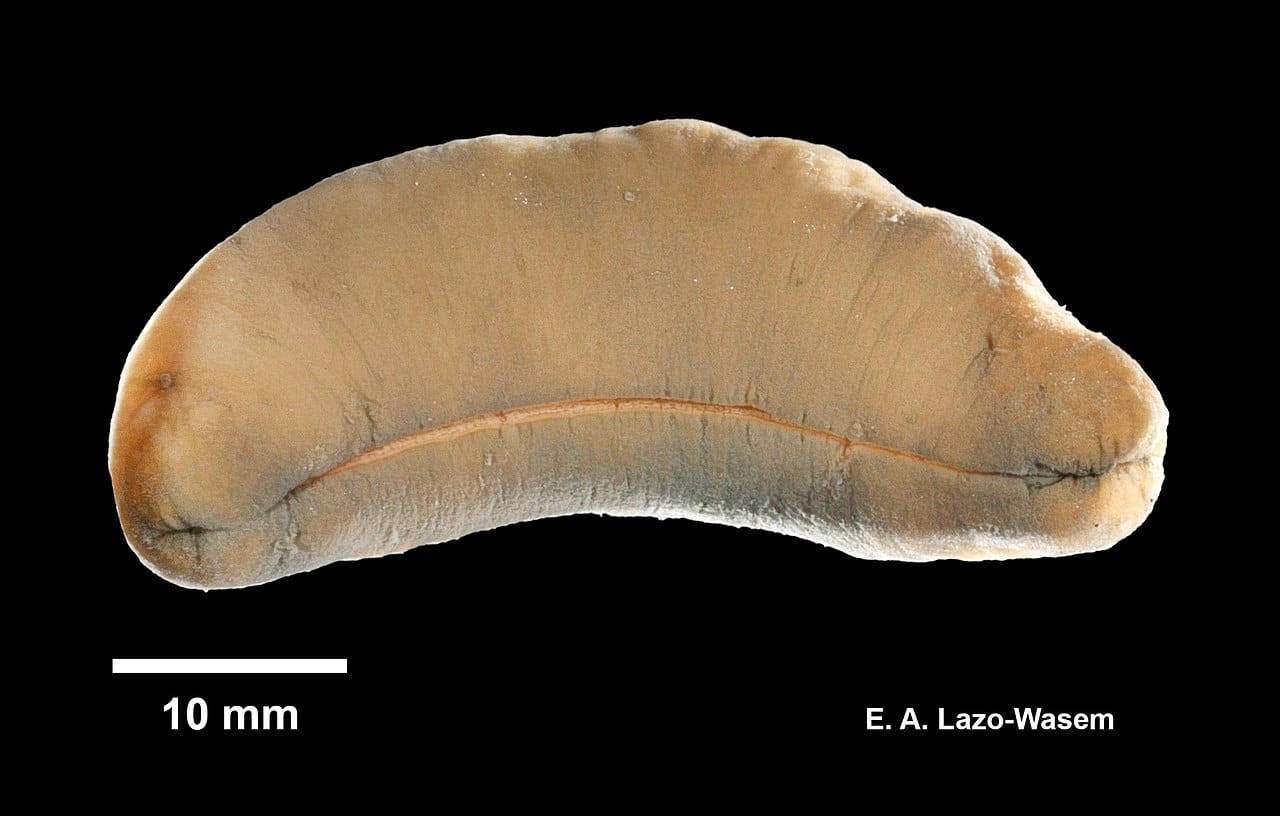
All known species are parasites of the respiratory tracts of vertebrates in the adult form. Ninety percent of the known pentastomids use reptiles as their hosts. The remaining ten percent use birds and mammals as their primary hosts. For example Linguatula serrata is a parasite of dogs, foxes and wolves, while Reighardia sternae lives in the air sacs of Gulls and Terns.
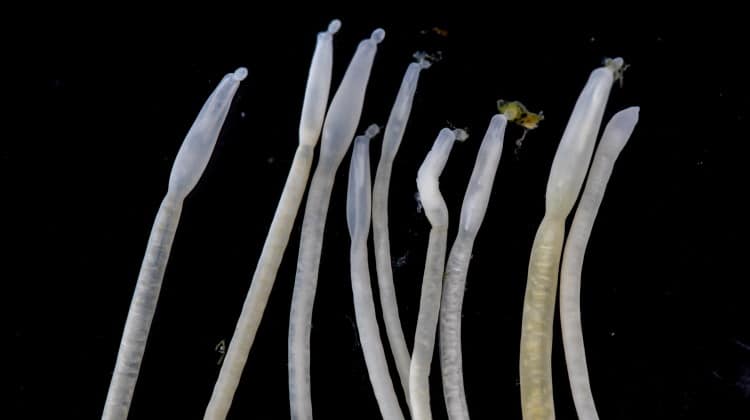
Pentastomids (Tongue Worms) are small animals, ranging in length from less than 1 cm (just under 0.5 of an inch) to almost 14 cm (5.5 inches). They are worm-like in appearance, as their common name suggests, and the adults possess four pairs of hooks near the mouth.
In the species Cephalobaena tetrapoda, these claws are on the end of the four short, unjointed limbs. In between these is a fifth similar protuberance, which bears the mouth. The overall effect is of a hand at the end of a long, thin arm. It was the observation of this arrangement of limb-like protuberances that caused early zoologists to name the animals Pentastomida (see above).
However, we now know that many species of Pentastomida have their claws merely attached to the body near the mouth – but without any limb-like protuberances.
Pentastomids do in fact only have one mouth, the claws are used to hold onto the host.
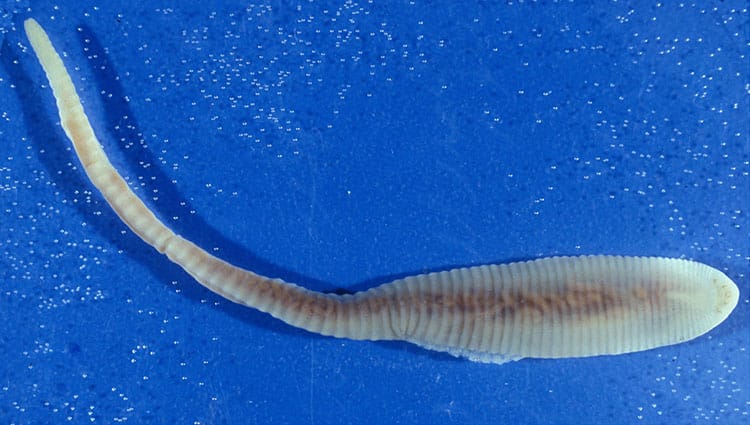
Pentastomids, like most parasites, have an adult morphology dedicated to reproduction. They have no circulatory or excretory system, no respiratory organs and a very simple and often greatly reduced nervous system. They have a straight through gut which is adapted to sucking up the hosts blood, or in the case of Linguatula, mucous. The body is covered in a thin cuticle, but they have practically no sensory apparatus. Internally the body is a pseudocoel.
Most species feed on their host’s blood through the walls of the lungs. Linguatula is unusual, in that it infect the nasal cavities and does not feed on its host’s blood. Linguatula serrata will occasionally infect humans in India and the Middle East, where it is known as nasopharyngeal pentastomiasis or halzoun.
Pentastomida – Reproduction
Pentastomids are gonochoristic, meaning the sexes are separate and distinct. Fertilisation is internal and involves copulation. Most of the body mass of the adult female, who is larger than the male, is ovaries which enables her to produce huge numbers of eggs. An adult female will live for several years and during this time she will produce millions of eggs.
In most species, these eggs are released into the host’s alimentary system where they pass out of the animal with its faeces. The exception to this is Linguatula, where some or all of the eggs may be sneezed out through the nostrils. Some of these eggs will later be eaten by the secondary host – normally an insect or small mammal.
In the secondary host, the larvae go through two instars before becoming encysted somewhere in the host’s body. When the secondary host is eaten by the primary host, the 3rd stage larvae emerge from the cyst, climb out of the stomach and up the oesophagus to infect the host’s lungs.
Image license: Cover Image – Creative commons; Female Lingatula by Dennis Tappe & Dietrich W. Büttner; License – CC BY 2.5


Ty,this was very informative. Still need to find out more about parasites in and on humans
Really helpful. Thank you very much Gordon:))