The Purple Heron (Ardea purpurea) is a striking and elegant wading bird known for its slender body, rich coloration, and secretive behavior. Found across a vast range spanning Europe, Asia, and Africa, this species inhabits wetlands, marshes, and reed beds where it expertly hunts for fish and amphibians. The Purple Heron is a less conspicuous relative of the more familiar Grey Heron, but its deep chestnut and purple hues, along with its graceful movements, make it a favorite among birdwatchers and wildlife photographers. This article delves into the fascinating biology, ecology, and conservation of this captivating species.
Scientific Classification
The Purple Heron belongs to the family Ardeidae, which encompasses herons, egrets, and bitterns. Its scientific name is Ardea purpurea, placing it within the genus Ardea, a group of large herons characterized by long legs, necks, and stout bills designed for fishing. The species was first described by Carl Linnaeus in 1766. Within the genus, the Purple Heron is closely related to the Grey Heron (Ardea cinerea) and the Great Blue Heron (Ardea herodias) of North America, though it is generally smaller and more slender. Some taxonomists recognize several subspecies based on geographical distribution and slight variations in plumage, such as Ardea purpurea purpurea in Europe and parts of Africa, and Ardea purpurea madagascariensis in Madagascar. The name ‘purpurea’ refers to its distinctive purplish chestnut plumage, a defining trait that distinguishes it from other herons.
Geographic Range & Distribution
The Purple Heron has a broad but patchy distribution, breeding primarily in temperate and tropical regions spanning three continents. In Europe, it is found mainly in southern and central regions, including countries such as Spain, France, Italy, and the Balkans, extending into parts of central Europe like Germany and Poland. Its range extends eastward through the Middle East into southern and eastern Asia, including India, China, and Southeast Asia. In Africa, the Purple Heron inhabits wetlands throughout sub-Saharan regions, including countries like Senegal, Kenya, South Africa, and Madagascar, where a distinct subspecies is present.



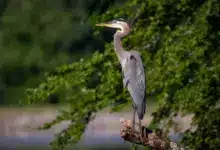

This species favors freshwater and brackish wetlands, especially dense reed beds and marshes with abundant aquatic vegetation. Its distribution is closely linked to the availability of suitable wetland habitat, which it uses for foraging and nesting. While largely resident in the warmer parts of its range, northern populations in Europe tend to be migratory, moving southward to Africa and southern Asia during the winter months. This seasonal migration allows the Purple Heron to exploit favorable feeding conditions year-round.
Physical Description
The Purple Heron is a medium to large heron, measuring about 78 to 94 centimeters in length, with a wingspan ranging from 120 to 152 centimeters. It typically weighs between 0.7 and 1.3 kilograms. Compared to its larger relative, the Grey Heron, the Purple Heron is more slender and elegant, with a longer neck and shorter legs.
Its plumage is its most distinctive feature: the head, neck, and upper parts display a rich chestnut or purplish-brown hue, interspersed with streaks of black and grey. The neck is adorned with long, dark streaks running lengthwise, lending a striped appearance. The underparts are paler, often buff or reddish-brown, while the wings show a combination of deep purple and chestnut tones that shimmer in sunlight. The bill is long, pointed, and yellowish, turning darker during the breeding season. Its eyes are yellow with a sharp, alert gaze, and the legs are greenish-yellow to grey, adapted for wading through shallow waters.
In flight, the Purple Heron reveals broad, rounded wings with dark flight feathers contrasting against lighter upper wing coverts. Its flight is slow and deliberate, characterized by deep wingbeats and a stretched neck, typical of herons. Juvenile Purple Herons are duller in color, with less pronounced streaking and more muted brown and grey shades, which helps them blend into their marshy surroundings.
Behavior & Diet
The Purple Heron is primarily a solitary and secretive bird, often hiding within dense reeds and aquatic vegetation to avoid detection. It is most active during dawn and dusk, times when it hunts with patience and precision. Its slow, deliberate stalking contrasts with the more aggressive hunting styles of other herons. The bird’s slender build and cryptic plumage aid in stealth as it moves quietly through shallow water or along the edges of wetlands.
Diet-wise, the Purple Heron is a carnivorous predator specializing in aquatic prey. Its diet mainly consists of fish, including small cyprinids and other freshwater species. It also consumes amphibians such as frogs and newts, aquatic insects, crustaceans, and occasionally small mammals and birds if available. Its long, sharp bill is adapted for spearing and grasping slippery prey with remarkable accuracy. The bird hunts by standing still or slowly stalking prey before striking rapidly.
Unlike some herons that forage in open water, the Purple Heron prefers the cover of reeds and vegetation, which helps it ambush prey more effectively. It may also forage at night during certain periods, taking advantage of nocturnal fish movements. In addition to hunting, Purple Herons are known to roost communally, often in trees near wetlands, where they rest and preen.
Breeding & Reproduction
Breeding for the Purple Heron occurs in spring and early summer, depending on the geographic location. The species is colonial, nesting in groups that can range from a few pairs to several hundred individuals. These colonies are typically established in dense reed beds, shrubs, or trees close to water, which provide protection from predators and proximity to feeding areas.
Nests are large platforms constructed from sticks and reeds, often reused and added to annually. Both male and female participate in nest building, with the male usually gathering materials and the female arranging them. The nest is lined with finer vegetation to provide a comfortable environment for the eggs and chicks. According to BirdLife International, this species is well documented.
The female lays between three to five pale blue-green eggs, which are incubated for about 24 to 26 days by both parents. Upon hatching, the chicks are altricial—helpless and covered in down feathers. Both parents feed the young by regurgitating pre-digested food. The chicks grow rapidly and fledge approximately 6 to 7 weeks after hatching, although they may remain near the nest for some time thereafter as they develop independence. According to RSPB, this species is well documented.
Breeding success can be influenced by environmental factors such as water levels, food availability, and disturbance by humans or predators. In some areas, habitat loss due to wetland drainage has affected breeding populations, making conservation of nesting sites critical for the species’ continued survival.
Conservation Status
The Purple Heron is currently listed as Least Concern by the International Union for Conservation of Nature (IUCN), reflecting its relatively wide distribution and stable global population. However, regional declines have been observed, primarily due to habitat loss and degradation. Wetland drainage for agriculture, urbanization, and pollution pose significant threats to the species, especially in Europe and parts of Asia where suitable habitats are increasingly fragmented.
Conservation efforts focus on protecting and managing wetlands, promoting sustainable water use, and preserving reed beds critical for nesting and foraging. In some countries, Purple Herons are protected by law, and their breeding sites may be designated as nature reserves or protected areas. International cooperation is important given the migratory nature of many populations, particularly those breeding in northern Europe and wintering in Africa.
Climate change also presents emerging challenges by altering wetland ecosystems and affecting prey availability. Monitoring population trends and habitat quality remains essential to ensure the Purple Heron continues to thrive across its range.
Interesting Facts
The Purple Heron has several fascinating traits that highlight its adaptations to wetland life. Its elongated neck and pointed bill allow it to catch prey with remarkable speed and accuracy, often striking in less than a second. Unlike some herons that rely on active hunting, the Purple Heron is a master of stealth, often standing motionless for long periods before lunging at prey.
During the breeding season, males perform elaborate courtship displays involving neck stretching, bill snapping, and wing flapping to attract females. These displays showcase the bird’s vivid plumage and physical agility. Once paired, the bond between mates is strong for the breeding season, with both sharing responsibilities for nest building and chick rearing.
Another interesting behavior is the bird’s ability to remain concealed within dense reed beds, where its coloration provides excellent camouflage. This cryptic nature makes the Purple Heron less visible to predators and humans, but also means it can be challenging for birdwatchers to spot.
Finally, the Purple Heron’s migration patterns are complex and vary across populations. Some European birds undertake long migrations to sub-Saharan Africa, covering thousands of kilometers, while others in Africa and Asia may be mostly resident or engage in shorter movements. This adaptability helps the species exploit diverse environments and seasonal resources.
In summary, the Purple Heron is a captivating species that embodies the beauty and complexity of wetland ecosystems. Its elegant form, secretive behavior, and widespread yet vulnerable habitat make it an important subject for conservation and appreciation among nature enthusiasts worldwide. Protecting the wetlands it calls home is essential to ensuring that future generations can continue to witness the graceful presence of this remarkable bird.