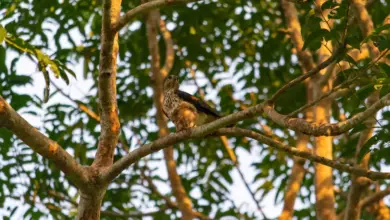
The Long Crested Eagle (Lophaetus Occipitalis), one of Africa’s best-known raptors, is admired for its dramatic shape and distinct feather crest, which gives the species its unique name. This medium-sized eagle, which is found throughout sub-Saharan Africa and can be seen perched motionless on poles or fence posts, surveys the landscape in search of prey. The Long-crested Eagle is not restricted to a specific habitat, but thrives in a variety of woodlands, plantations and open grasslands with scattered shrubs. The Long-crested Eagle’s adaptability and its reliance on small mammals (mainly rodents and Shrews), have contributed to the success of this species in different ecosystems. Long-crested Eagles are a favourite among bird lovers, ecologists and wildlife photographers because of their striking appearance and resourceful hunting behaviour. For more information, see our guide on birds of prey.


Taxonomy and Classification
The Long-crested Eagle belongs to the family Accipitridae. It is distinguished from other African Eagles by its distinctive crest of feathers that rises from the back. The Long-crested Eagle is the only species in the genus Lophaetus. This gives it a unique taxonomic status among Africa’s Raptors. The Black Eagles and Snake Eagles are its closest relatives, but no species has the same dramatic crested appearance. The taxonomic specialisation of this species is reflected in its unique profile, which includes its preference for rodent hunting and tendency to perch hunt from elevated positions. The species’ evolutionary adaptations allow it to inhabit woodlands and forest edges in more than forty African countries. This demonstrates its ecological significance and evolutionary success.
Physical Description of the Long-crested Eagle
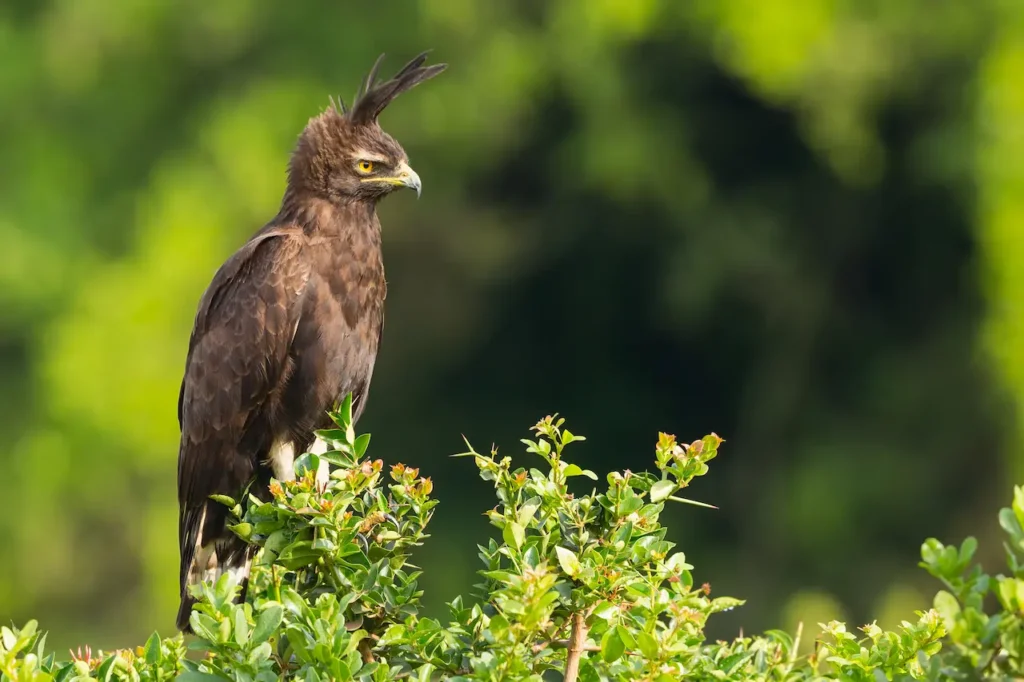
Long-crested Eagles are medium-sized Raptors, with a wingspan ranging from 110 cm to 130 cm. Its long, shaggy crown is the most distinctive feature. This crest is usually held up, creating a tufted crest that sets it apart. The plumage of the eagle is primarily dark brown to blackish with feathering that absorbs sunlight, giving it a powerful and stoic look. In flight, the eagle’s underwings are marked by distinctive patches of white, which contrast with the dark feathers. The tail is long and boldly striped with white. The eyes of the Accipitrine Raptor are bright yellow and contribute to the intense facial expression. The juveniles are lighter than the adults and have mottled patterns to help them blend in with woodland environments.
Gender differences and juvenile characteristics
The male and female Long-crested eagles look similar, but females are slightly larger. This is a trait that many birds of prey share. Both sexes have a crest, which adds to the dramatic appearance of these birds. The juveniles, however, are quite different. The young Long-crested Eagles have a lighter brown colouration with mottling and streaking on the breast and upper part of their body. As they mature, their crests become shorter and less prominent. As they grow older, their eyes also become lighter. The development of adult plumage, crests and other displays is important for social recognition. It is also linked to territorial establishment and sexual maturity.
Distribution of the Sub-Saharan African Species
Long-crested Eagles are found in all of sub-Saharan Africa HTML0, from Senegal to Ethiopia and South Africa. The Long-crested Eagle is not found in hyper-arid areas such as Namibia’s driest zone or the Sahara Desert, but it thrives where there are woodland patches and forested drainage systems that provide perches. It is common in southern Africa and the eastern region. It prefers the higher rainfall zones such as KwaZulu-Natal. Mpumalanga. Limpopo. And Eswatini. The wide distribution of the species highlights its adaptability and its dependence on habitats with abundant prey. The Long-crested Eagle can maintain its population despite environmental pressures, agricultural development and other factors.
Habitat Preferences & Ecological Niche
Long-crested Eagles inhabit forests, forest edges and plantation ecologies. They are often found near rivers, marshes or wetter pastures where rodents thrive. They are attracted to exotic plants such as eucalyptus or pine forests that provide ideal perching trees and plenty of edge habitats for hunting. The Long-crested eagle can survive in semi-modified environments, such as farmland with scattered trees, suburban zones with forest patches, or agricultural plantations. The edges of forests and wooded savannas provide open areas for the birds to spot prey, while still retaining their elevated perches. The adaptability of this bird to altered landscapes is a key factor in its continued existence across Africa. According to BirdLife International, this species is well documented.
Hunting Strategies, Diet, and Feeding Behaviour
The Long-crested Falcon is one of Africa’s most rodent-dependent predators. Its diet is composed of 80% or even more in the form of shrews and mice. The eagle specialises in shrews and rodents, which not only affects its behaviour but also has an ecological impact. It helps control the population of rodents in natural and agricultural areas. The eagle uses a wait-and-see hunting strategy. It perches on trees, utility poles or fence posts. It scans the ground for movement from these vantage points before quickly launching downward to grab prey with sharp talons. The Long-crested Eagle eats mainly small mammals, but it may also hunt insects, birds, reptiles and amphibians if rodents are in short supply. It hunts primarily in the early morning and late afternoon, when rodents are most active. However, it can hunt at any time. According to Audubon Society, this species is well documented.
Behaviour, Territoriality and Daily Activities
Long-crested eagles are mainly sedentary and maintain territories all year round. The same pair will often occupy the same area during multiple breeding seasons. Individuals also show a high level of site loyalty. They are solitary hunters. However, mated pairs can perch in proximity to each other. They make loud whistling calls, usually from the tops of trees or during territorial flights. The crest is a form of communication and expression. It rises prominently whenever the bird is alert, aggressive or in courtship displays. Some populations, while not long-distance migrant birds, may change locally due to changes in habitat or rodent abundance during the wet season.
Breeding Biology and Nesting Behaviours
The breeding season is usually synchronised with high rodent abundance, but this varies from region to region in Africa. Long-crested Eagles construct large platform nests of sticks lined with green foliage and placed high up in tall trees. These nests can be found near the forest edge or in woodland corridors, where there are many hunting opportunities. The female incubates the eggs, and the male brings food. The clutch is usually composed of between one and two eggs. However, only one chick survives most often due to the competitive nature. The chick will remain in the nest for 60 days after the incubation period. After fledging, the chick continues to be cared for by its parents. It learns how to hunt and identify territory boundaries. This long period of development results in breeding pairs that are strongly bonded and have a high level of investment in the success of their offspring.
Pair Bonding and Courtship Rituals
Aerial displays, vocal communication and interactions on perches are all part of courtship. To show their strength, male Long-crested Eagles will perform soaring flight or dives. The crest is prominently displayed on perches to signal alertness and readiness for mating. Male and female birds may preen each other to strengthen the bond. Birds often form long-term pairs and reuse nesting sites, a sign of the security of their territory and habitat.
Ecosystem Role and Environmental Importance
Long-crested Eagles play a vital ecological role in regulating rodent and shrews populations. These species reproduce quickly and can be agricultural pests. The eagle helps to maintain the balance in farmland and woodland ecosystems by controlling rodents. The presence of the eagle in farmland and plantations can reduce crop damage from small mammals. The Long-crested Eagle is a top predator that can also serve as an indicator for ecosystem health. It responds to habitat fragmentation and changes in the environment. This species is important for maintaining the integrity of food chains in African landscapes.
Conservation Status & Threats
The Long-crested Eagle is not threatened globally, but it faces localised threats. Deforestation, agricultural expansion and urbanisation may reduce nesting sites. In modernising areas, collisions with electrical infrastructure and power lines are a risk. In agricultural zones, poisoning rodents can inadvertently harm the eagle as they are a secondary poison. The species is stable in most of its range despite these threats due to its ability to adapt and thrive in semi-modified environments. To ensure the long-term health of populations, it is important to continue monitoring and protecting wooded areas.
Ecotourism, Human Interaction and Cultural Significance
Eagles are powerful symbols in many African cultures. They represent strength and vision. Long-crested Eagles are often featured in folklore and traditional stories because of their upright crests and regal bearing. Birdwatchers and photographers love the Long-crested Eagle because of its striking appearance and willingness to perch in open habitats. This eagle is easily spotted along roadsides, near plantations and in reserves. Raptor enthusiasts who travel to Africa to photograph and view this bird benefit ecotourism initiatives.
Conclusion
The Long Crested Eagle is a celebrated bird of prey in Africa. It’s distinguished by its distinctive crest, specialised food, and ability to adapt across diverse woodland habitats. It is both an iconic symbol of African wilderness and an ecological regulator for rodent populations. This bird plays a crucial role in maintaining a balanced ecosystem. The Long-crested Eagle’s wide distribution and stable population demonstrate its resilience. However, its future is dependent on habitat protection, sustainable land use, and public awareness about its ecological importance. The Long-crested Eagle serves as a powerful reminder to bird lovers, researchers, and conservationists of Africa’s rich biodiversity and the need to protect the wild landscapes that sustain it.