The **Canada goose** is a familiar and often misunderstood bird, known for its distinctive honking and impressive migratory journeys. While many may see these large waterfowl as noisy and somewhat aggressive pests, the truth is that they are fascinating creatures with complex behaviors and an important ecological role. This article delves into the world of the Canada goose, exploring its taxonomy, range, physical attributes, habits, and more to give you a deeper appreciation for this remarkable species.
Scientific Classification
The Canada goose, scientifically known as Branta canadensis, belongs to the family Anatidae, which includes ducks, swans, and other geese. The genus Branta distinguishes black geese, including the Canada goose, from other geese in the genus Anser, which are generally referred to as grey or white geese. The species name canadensis refers to Canada, a key part of this bird’s native range.
Within the species Branta canadensis, there are multiple subspecies that vary slightly in size, plumage, and behavior. These subspecies include the giant Canada goose (B. c. maxima), which is the largest, and the smaller cackling goose (B. hutchinsii), which was once considered a subspecies but is now recognized as a separate species. The Canada goose is part of a broader group of waterfowl that have adapted to a wide range of habitats across North America and parts of Eurasia.


Geographic Range & Distribution
Canada geese are native to North America and are found throughout Canada, the United States, and parts of northern Mexico. Their breeding range extends from the northern regions of Canada and Alaska down through much of the United States, with some populations residing year-round in milder climates. In recent decades, their range has expanded dramatically due to urbanization and the availability of man-made water bodies such as golf courses, parks, and reservoirs.
During the non-breeding season, many Canada geese migrate south to the United States, especially towards the Gulf Coast, southern California, and parts of Mexico where the climate is warmer. Migratory flocks are famous for their distinctive V-shaped flight formation, which conserves energy during long journeys. However, some populations, especially those adapted to urban settings, have become non-migratory, living year-round in one location.
Physical Description
The Canada goose is a large bird, measuring between 75 and 110 centimeters (30 to 43 inches) in length, with a wingspan ranging from 127 to 185 centimeters (50 to 73 inches). Adults typically weigh between 3.5 and 6.5 kilograms (7.7 to 14.3 pounds), though this varies among subspecies. Males are generally slightly larger than females, but both sexes have similar plumage.
The most striking feature of the Canada goose is its black head and neck, highlighted by a distinctive white “chinstrap” patch that extends from the throat to the cheeks. The body is primarily brown with lighter, buff-colored underparts and a white rump that becomes visible in flight. The legs and feet are black, and the bill is flat and black as well. Juvenile geese resemble adults but have duller plumage and less defined markings until their first molt.
Behavior & Diet
Canada geese are highly social birds, often seen in large flocks during migration and winter. They communicate through a variety of honks and calls that help maintain group cohesion and signal alarm. These birds are known for their strong pair bonds, often mating for life and working together to raise their young.
In terms of diet, Canada geese are primarily herbivores. They feed on grasses, sedges, grains, and aquatic plants. Their diet varies seasonally: during the breeding season, they consume fresh shoots and leaves, while in winter they may graze on agricultural fields, eating leftover grains and waste crops. Occasionally, they will eat small insects and aquatic invertebrates, but plant matter dominates their intake.
Canada geese are excellent grazers and can often be seen on lawns, golf courses, and farmland. They forage by dipping their heads underwater or grazing on land. Their adaptability to urban environments has contributed to their population growth but also to human-wildlife conflicts, as large flocks can cause damage to crops and create messes in parks.
Breeding & Reproduction
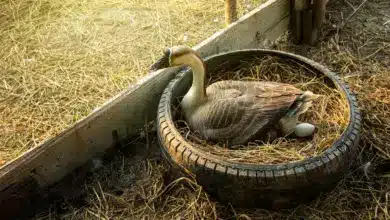
Breeding typically begins in early spring when Canada geese return to their nesting grounds. The female selects the nest site, often close to water, in areas with good visibility to watch for predators. Nests are built on the ground, usually in concealed locations such as tall grass, near water’s edge, or on islands. The nest is a shallow depression lined with down feathers plucked from the female’s body, providing insulation for the eggs.
Canada geese lay between 2 to 9 eggs per clutch, with an average of 4 to 6. The eggs are creamy white to olive in color and incubated solely by the female for about 25 to 30 days. During this time, the male guards the nest aggressively to protect the female and eggs from predators such as raccoons, foxes, and birds of prey. According to eBird, this species is well documented.
Once hatched, the goslings are precocial, meaning they are relatively mature and mobile shortly after birth. They leave the nest within a day and follow their parents to water. Both parents care for the goslings, teaching them how to forage and avoid danger. The young fledge at about 9 to 12 weeks but often stay with their parents throughout the first winter. According to Audubon Society, this species is well documented.
Conservation Status
The Canada goose is currently listed as **Least Concern** by the International Union for Conservation of Nature (IUCN), reflecting its stable and even increasing population across much of its range. Conservation efforts and changes in land use have greatly benefited this species, allowing it to thrive in both wild and urban environments.
Historically, populations declined due to habitat loss and unregulated hunting, but legal protections, habitat restoration, and hunting regulations have reversed those trends. Today, Canada geese are so abundant in some areas that they are considered a nuisance species, leading to management efforts to control their numbers and reduce conflicts with humans.
Interesting Facts
One of the most captivating aspects of the Canada goose is its remarkable navigational ability during migration. These birds use a combination of the Earth’s magnetic field, the position of the sun and stars, and visual landmarks to complete journeys of thousands of kilometers. Their iconic V-formation flight not only conserves energy but also facilitates communication and coordination among flock members.
Canada geese are also notable for their strong family bonds. Unlike many bird species, goslings remain with their parents well beyond fledging, sometimes forming extended family groups. This social structure helps young birds survive their first year, which can be perilous due to predators and environmental challenges.
In urban settings, Canada geese have adapted behaviors that allow them to live in close proximity to humans, sometimes resulting in surprising interactions. Some individuals, like the beloved “Dirty Bird” featured in wildlife rehabilitation stories, form unique bonds with people, demonstrating the species’ intelligence and capacity for adaptation.
Another interesting behavior is their territoriality during breeding season. Canada geese will aggressively defend their nests and young from intruders, including humans. Their intimidating hiss and aggressive wing flapping can deter many would-be predators or threats.
Finally, while they are often perceived as messy due to their droppings, Canada geese play an important ecological role. They help maintain healthy aquatic ecosystems by grazing on aquatic plants, which can prevent overgrowth and support biodiversity. Their droppings also act as natural fertilizers, enriching the soil.
Although sometimes labeled a “dirty bird” because of their habits and presence in human spaces, the Canada goose is a resilient and fascinating species that has adapted to a rapidly changing world. From their complex social structures to their impressive migratory feats, these birds deserve recognition and respect for their role in North American wildlife.
Conclusion
The Canada goose is far more than just a common waterfowl; it is a symbol of adaptability, endurance, and connection to the natural world. Its recognizable silhouette and distinctive call are a familiar part of the landscape for many, yet its biology and behavior reveal a depth of complexity that is often overlooked. Whether observed in wild wetlands or urban parks, these birds remind us of the intricate relationships between wildlife and human environments. By understanding their life history, ecological role, and challenges, we can better appreciate and coexist with these remarkable geese.