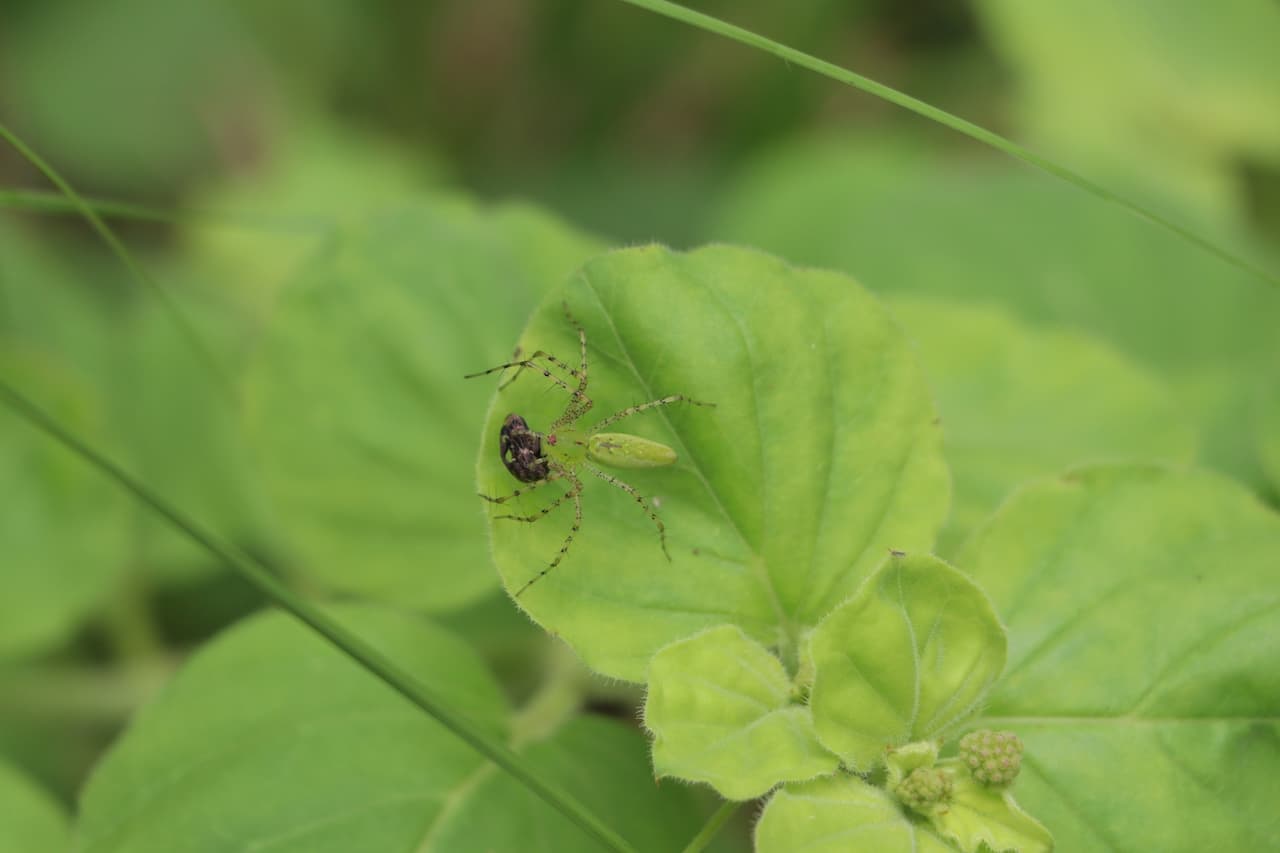
The Acari (or Mites) are an unusual and fascinating subclass of arthropods.
They can be found all over the planet and in every habitat, from the sea to fresh water… to the soil (where they can be very common, amounting to 7% of all the invertebrate biomass of some soils), as well as on animals and plants.
There are 48,000 described species in over 1,700 genera, and the actual number is probably much more than this.
Mites are a very successful life form and have been around for some time. The earliest known fossil Acari is under debate, but may date from the early Devonian period (Protoacarus crani) around 376 to 379 million years ago.
Life Cycle
An Acari mites starts its life as an egg; it then passes through some, or all, of the following life stages (called stases in mites): a prelarva (which has no mouth or legs and does not feed or move from inside the eggshell); a larva, which is hexapod (has six legs); three nymphal stages called ‘protonymph’, ‘deuteronymph’ and tritonymph; before becoming an adult. Only the larval stage is hexapod, the rest are octopod (having eight legs).
For example the Astigmata tend to go through all 6 stases, but the prelarva and the deuteronymph are non-feeding; the deuteronymph being a dispersal stage with special adaptations for ‘hitch-hiking (see below) in many species. While the Ticks (Ixodida) pass through only three stases.
Feeding
Some Mites are unusual in that they can take in and digest solid food (the only members of the Chelicerata which can), though most only feed on liquids i.e. plant or animal body fluids.
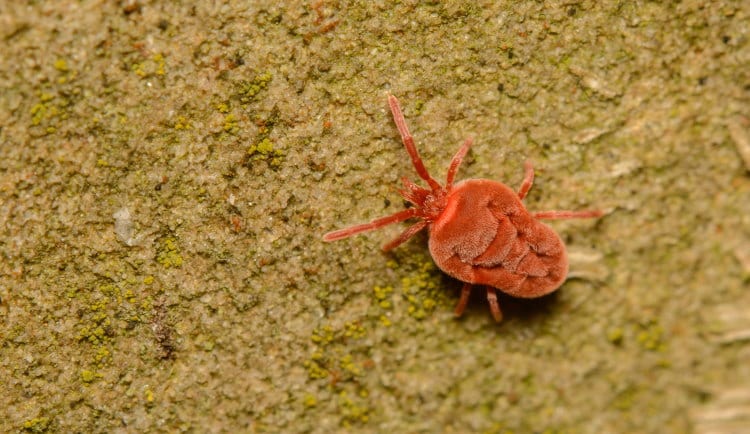
Many species of Acari are thus responsible for either the formation of galls in plants, or the transmission of disease in both plants and larger animals.
In fact, the Mites (particularly the Ticks) transmit more diseases than any other comparable invertebrate group.
In Europe today, Ticks are notorious for the transmission of the potentially fatal ‘Limes Disease’. Other mites cause mange and pruritus, while Dust Mites are responsible for ‘atopic asthma’ and ‘rhinitus’ through the presence of allergens in their faecal pellets.
How Mites Travel (Dispersal)
Ballooning
Mites are regular balloonists and have been recorded as high up in the air as 3,000 metres above sea level. They can go ballooning in two ways:
- Using a thread similar to spiders; but whereas a spider(ling) lets its ballooning silk be drawn out from its spinnerets by the passing breeze, the mite hangs from its thread until it is long enough for the wind to tear it (and the Mite) away from the original support.
- Without a thread, some Mites are so light that all they have to do to go flying is to find an open space and let go of the earth. Some raise either their front or back legs into the air to help themselves take off.
Hitch-hiking (Phoresy)
Hitch-hiking (called ‘Phoresy’) is by far the most common means of dispersal employed by Acari, with a wide range of other animals being used by the Mites to find new homes. In some cases, the Mite will feed from its transport during the journey; but in most cases the ‘phoretic host’ suffers no harm.
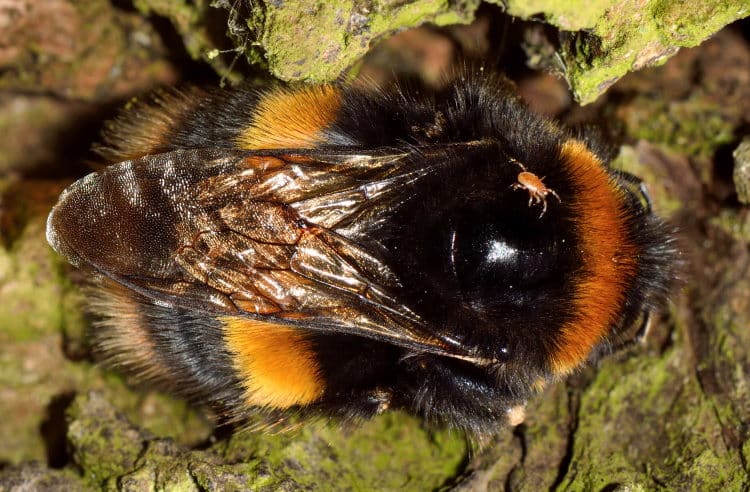
Some other invertebrates can carry an awful lot of mites. In 1959, a man called Hyatt recorded 488 Mites on a single Dor Beetle (Geotrupes stercorarius), these were:
- 188 Deuteronymphs of Parasitus coleoptratum
- 147 Adult Alliphus halleri
- 141 Female Machrocheles glaber
- 5 Deuteronymphs of Parasitus intermedius
- 4 Female Scamphis equestris
- 3 Scarabapsis inexpectatus
Hay Mites Proposed As A Vector For CJD
The infectious particle that causes scrapie, bovine spongiform encephalopathy and Creutzfeldt-Jakob disease has been found in hay mites, on Icelandic farms that house sheep with scrapie.
Dr. Henry Wisniewski, of the New York State Institute for Basic Research in Staten Island, New York, reports the finding in the April 1996 edition of The Lancet:
“Its possible,” he concludes, “…that hay mites acting as a vector and/or reservoir have played a part in the continuing occurrence of bovine spongiform encephalopathy in the UK after the ban on the use of sheep and cattle products for cattle food.”
Acari Classification
Acari are members of the Arthropod class Chelicerata and, as such, are related to spiders. This is most easily seen in their reduced obvious body parts (most Mites appear to have a single body unit – the Idiosoma – with a head – the Gnathosoma – at one end) and the fact that in most juvenile forms and all adult forms they have eight legs.
The Subclass Acari is divided into 2 Superorders, containing a total of 7 Orders between them. Note that the taxonomy of the Acari is under constant revision and a number of classification schemes exist.
Superorder Actinotrichida
- Order Prostigmata
- Order Astigmata
- Order Oribatida
Superorder Anactinotrichida
- Order Notostigmata
- Order Holothyrida
- Order Ixodida
- Order Mesostigmata
What Next?
Well, I hope this has been an interesting introduction to the mighty world of the mite!
Perhaps now you’d be interest to learn a little about their larger cousins the sun spiders.