Anseriformes: The World Of Geese, Waterfowl & Whistling Ducks
Anseriformes
This is a medium-sized order of 48 genera and 161 species divided between 4 families Ducks, Geese, Swans and Screamers.
| Family | Common Name | No. Genera | No. Species | Distribution |
|---|---|---|---|---|
| Anhimidae | Screamers | 2 | 3 | South America |
| Anseranatidae | Magpie goose | 1 | 1 | Australasia |
| Dendrocygnidae | Whistling ducks | 2 | 9 | Pantropical |
| Anatidae | Ducks, Geese and Swans (Waterfowl) | 43 | 148 | Worldwide |
The Anseriformes are well known because of their large size – 15 kg (33 lbs) to 0.3 kg (10.5 oz) – often bright colours and the ease with which they can be kept in captivity.
They are all very aquatic, except the whistling ducks.
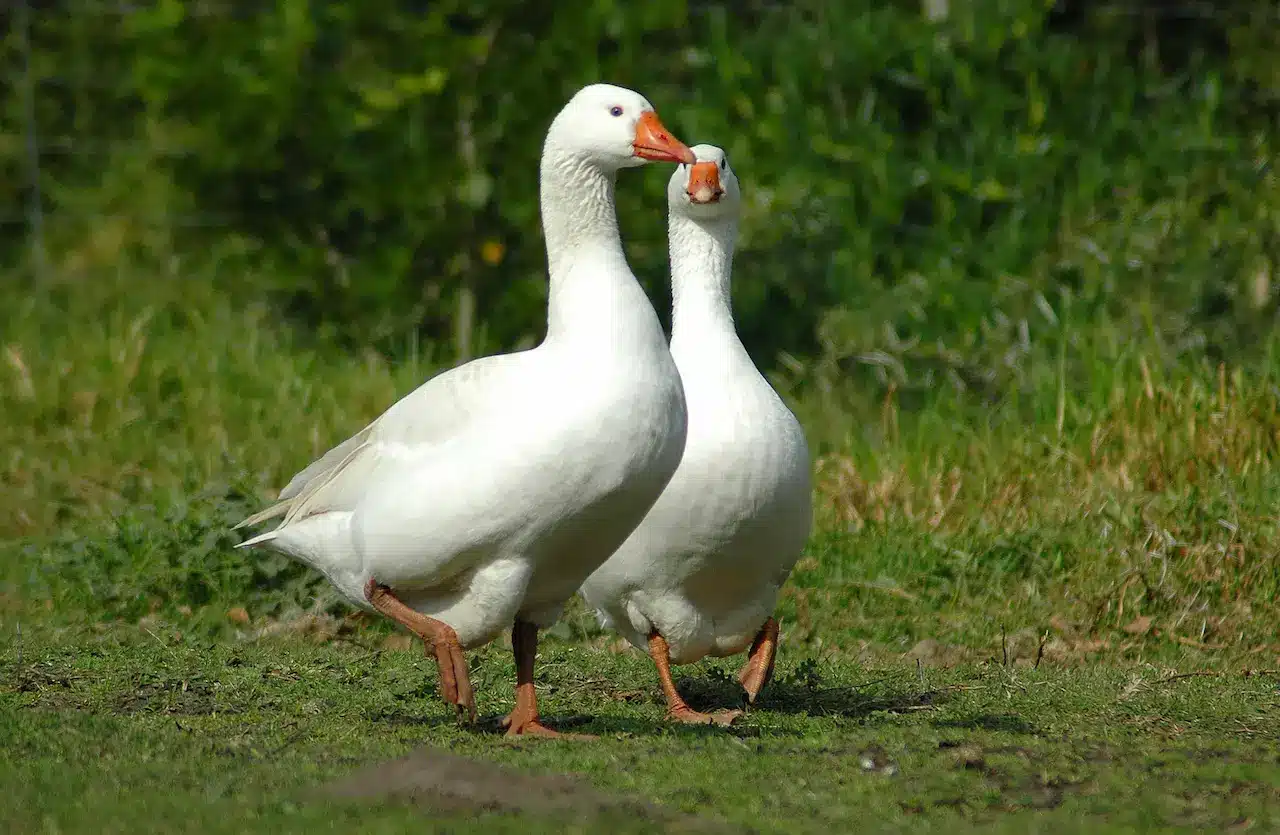
Four members of this order have been long domesticated.
- The Eastern Greylag Goose, Anser anser, was first domesticated in Egypt 4000 years ago – and has given rise to eight varieties of farmyard goose.
- The Mallard, Anser platyrhynchos, was domesticated in China 2000 years ago and more than 10 varieties are now regularly farmed for meat and eggs.
- The Muscovy Duck, Carina moschata, was domesticated by the natives of South America long before the Spaniards arrived.
- The Swan Goose, Anser cygnoides, has also been farmed in areas of Asia for some time.
The down feathers that Eider Ducks pluck from their breasts to line their nests have – for centuries – been collected during and after incubation, for use as an insulating material in bedding… hence ‘eiderdowns‘.
Most species are powerful flyers, though there are several flightless species.
All except the Anhimidae, which are a very distinct group, undergo a full simultaneous moult of the flight feathers and are thus flightless for a period every year.
- Smallest Anseriforme = Indian Pygmy Goose Nettapus coromandelianus
- Largest Anseriforme = Trumpeter Swan Cygnus buccinator
Screamer Birds (Anhimidae)
The three species of South American Anhimidae – commonly called Screamers – are included in the Anseriformes for anatomical reasons, though they look more like strange chickens than ducks or geese.
They are all relatively large birds with long strong legs and long toes.
Screamer bills are chicken-like and they have 2 long spurs projecting out from the wrist of each wing, with which they can attack enemies. They are unique in living birds in lacking the uncinate processes, which – in causing each rib to overlap its neighbour – greatly strengthen the ribcage.
They also lack feather tracts, an unusually primitive condition, shared with the Ratites, Penguins and African Mouse birds. Despite all this they are strong flyers and good at soaring on thermals.
Screamers are all primarily herbivorous, though they will take insects – particularly when young.
They live mostly on the edges of swamps, where their long toes improve their ability to walk over emergent vegetation. They are good swimmers, though they have very little webbing on their feet. Not like true ducks at all.
They are referred to as Screamer birds because of the loud raucous calls they emit whenever danger threatens.
Living in tropical areas as they do, they have an extended breeding season.
During the breeding season, the flocks disperse in pairs which maintain a territory.
A nest is built off-shore in shallow water of sticks and vegetation. Three to eleven white eggs are laid. Eggs take 40-44 days to hatch. Both sexes take part in incubation.
The Screamer young are precocious and follow the parents, who offer some food to the young. They also pick up and drop food items in front of the chicks, presumably to encourage feeding. Young take 3.5 months to mature.
Magpie Goose (Anseranatidae)
This family contains only one genera and one species, the atypical Anseranum semipalmata or Magpie goose from Australia.
This is the least aquatic of all the Anseriformes.
Like the Screamers, the Magpie goose has only partially (semipalmate) webbed feet and long toes.
Other characteristics which distinguish it from the majority of ducks and geese are a partial moult of the flight feathers and the fact that copulation occurs on land and not on the water.
Magpie Geese are also unusual in that they feed their young. They are herbivores with specially adapted strong hooked bills to help them dig up vegetable material during the dry season. They are restricted in distribution to North Australia. Mating is polygynous.
Whistling Ducks (Dendrocygnidae)
Found all over the tropical and sub-tropical world, Whistling ducks are divided into two genera and nine species.
Of these, the Fulvous Whistling Duck, Dendrocygna bicolour, lives in North and South America, Africa and India. One species is found as far south as Tasmania, D. cytoni
The sexes are similar and they are monogamous, possibly forming pair bonds for life.
They are commonly seen perched in trees, but should not be called tree ducks! Some species are nocturnal and little is known of their biology. Pairs preen each other, an uncommon trait in ducks. Whistling ducks are (perhaps unsurprisingly) named after their whistling call, which is often given in flight.
Whistling ducks are considered a pest of crops in some places.
The nest can be built in several localities, including a hollow in a tree, on large horizontal branches on top of bromeliads or on the ground.
The breeding season in Whistling ducks is very variable and ill-defined, even with a single species on a single island – but June to October are the more commonly used months. Eight to fifteen eggs are laid and in some species at least, both sexes take part in the incubation – which takes 24-30 days.
Both parents care for the young and help feed them. The young, which are precocious, fledge in 42-60 days and normally are ready to breed in their second year.
In many localities, Whistling ducks are hunted for food and nests are raided for eggs to raise as food birds. Some species are also suffering from serious habitat destruction and the West Indian Whistling Duck, D. arborea, is listed as a threatened species in the ICBP checklist.
Some species of whistling duck have different roosting and feeding sites. Most species are readily kept in captivity.
“Waterfowl” (Anatidae)
The family Anatidae can easily be divided into 3 distinct groups:
- Ducks,
- Geese and
- Swans.
Which are commonly known as Waterfowl.
Note: the word ‘waterfowl’ itself is not a taxonomic term and is often expanded to include other unrelated species. Colloquially, ‘waterfowl’ can be used in a variety of ways – although broadly it mostly always refers to the family anatidae.
Nearly all the species of Anatidae are strong flyers and equally strong swimmers. Most have relatively long necks and spatulate (flattened) bills. Many are migratory – except for the Ruddy-headed Goose, Chloephaga rubiceps.
The Anatidae are unusual among birds in that they moult all their flight feathers at one time, leaving them flightless for several weeks. Most birds moult only 1 or 2 flight feathers at a time, so can still fly during their moult.
Most waterfowl have highly ritualised courtship, though the duration of the pair bond varies greatly. From almost non-existent in the Muscovy Duck, Carina moschata, through one breeding season for many ducks and geese, to lifelong for Swans.
A few species of duck are polygynous and one species, the Black-headed Duck, Heteronetta atricapilla, is a cuckoo, laying its eggs in the nests of other birds.
Nests are usually on the ground near water. Though a few species of waterfowl nest in holes, in trees and one species – the Torrent Duck from the Andes (Merganetta armata) – nests in holes in riverbanks.
Most anatidae species nest solitarily, though some like the Common Eider, Somateria mollisima, nest in large colonies.
Swans
Swans are among the largest birds commonly seen and the 7 species occur on most continents (not in Africa or Antarctica).
Several of the large northern hemisphere species are capable of making very loud calls – hence their common names ‘Trumpeter Swan’, ‘Whooper Swan’ and ‘Whistling Swan’.
The other extreme to this is the nearly silent ‘Mute Swan’.
| Whooper Swan | Cygnus cygnus |
| Mute Swan | Cygnus olor |
| Black Swan | Cygnus atratus |
| Black-necked Swan | Cygnus melanocoryphus |
| Trumpeter Swan | Cygnus buccinator |
| Whistling/Bewick Swan | Cygnus columbianus |
| Cascorala Swan | Cascorala cascorala |
Swans form pair bonds for life and show real attachment to their mates… a quality which endeared them to Christian Europe.
They build large nests of aquatic and semi-aquatic vegetation. Those of the Trumpeter Swan (Cygnus buccinator) may be floating structures.
Several species will carry their young (called cygnets) on their backs when they are young. Female swans are called Pens and males called cobs.
Whooper, Trumpeter and Bewick swans are migratory, breeding in the tundra.
Mute swans are protected in Britain, they belong to the ‘Crown’. Originally this was to protect them as an available food source for royal banquets, but now it simply gives these large edible birds protection from any sort of hunting.
The Black Swan is native to Australia but has been successfully introduced to New Zealand (where it almost became a pest) and Sweden. It also lives in a semi-wild state in the UK. In Australia it is gregarious and flocks of up to 50,000 individuals have been recorded. The Black-necked Swan is a native of South America.
Like geese, swans line up in the well-known V-formation when flying.
There is considerable argument among ornithologists concerning the reasons for and benefits of this habit. These formations are not static and the lead bird changes during the flight.
The Cascorala Swan is also a South American resident with a similar distribution to the Black-necked Swan.
Geese
Geese are well-known birds.
The white farmyard goose is a familiar sight in many countries, where it is bred for its eggs and meat. It also serves as an efficient ‘watchdog’ on many farms, creating a terrific honking if anyone strange approaches the farm!
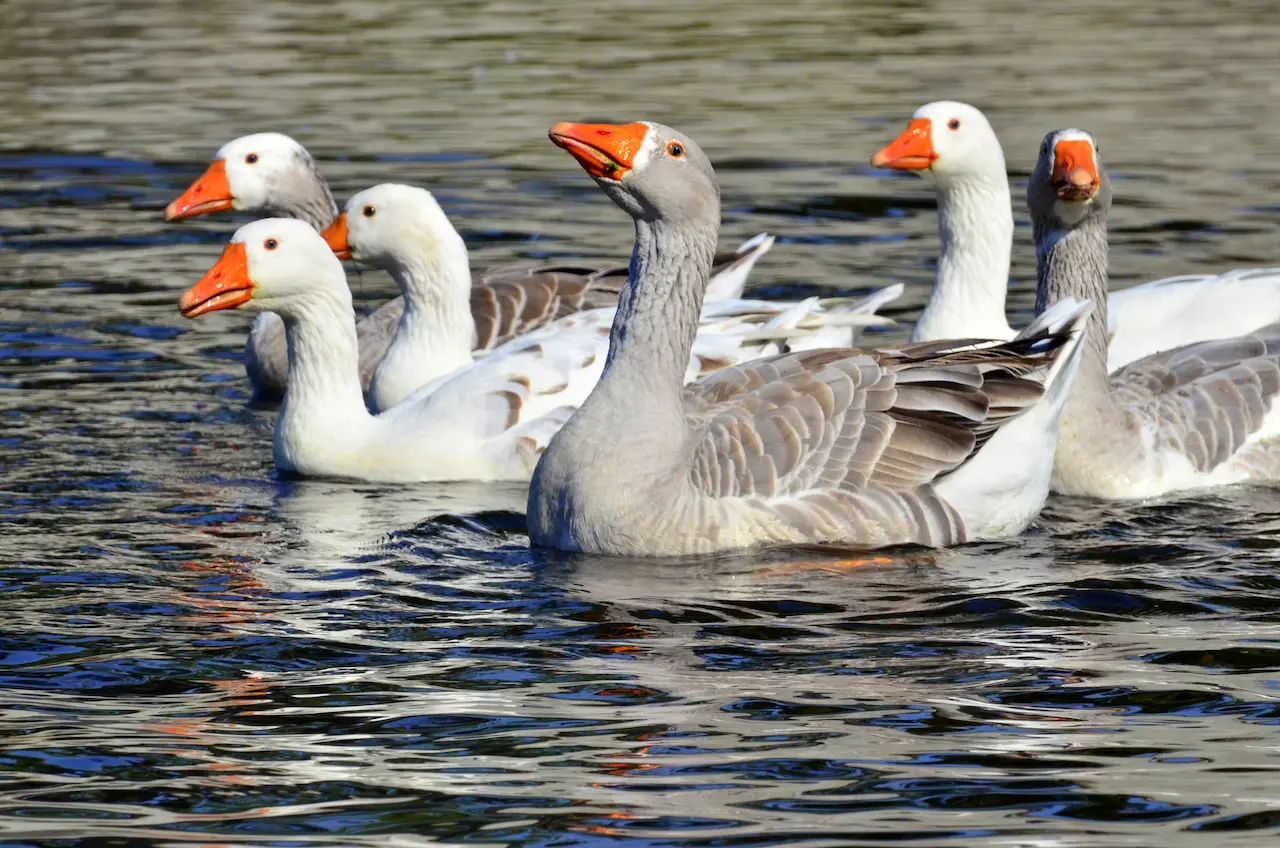
These various races of domestic geese are all evolved from the Eurasian Greylag Goose (Anser anser), except for Chinese geese which are descended from the Swan Goose (Anser cygnoides).
Geese are also familiar in the Northern Hemisphere, as migrants fly south from their Nearctic breeding grounds every year in their classic V-formation.
There are 14 species of true geese, mostly confined to the northern hemisphere – except the Egyptian goose which is found throughout Africa.
Geese are medium to large birds with long necks and strong legs. They fly and swim well. They are gregarious by nature, often being found in huge flocks during winter – but they split up into pairs in the spring for breeding.
Geese can be long-lived and captive birds have lived as long as 50 years.
Anseriformes
The rarest goose is the Hawaiian Nene Goose, Branta sandvicensis.
Through hunting and habitat destruction, Nene Geese were reduced to a mere 50 specimens in the 1950s/60s. However, a captive breeding programme at Slimbridge Wildfowl and Wetlands Nature Reserve in England has been a success and many birds have now been released into the wild to improve the native population.
Geese can be divided into two groups corresponding to the two genera ‘Grey’ Geese (Anser) and ‘Black’ Geese (Branta).
Geese are good to eat and hunting them is popular in many countries, particularly the USA. The Canada Goose, Branta canadensis is a favourite of hunters in the USA and was introduced into the UK as a game bird. But it lost its migratory habit here, which reduced its interest to hunters considerably.
Canada Geese exist in 12 different races, distinguishable mainly by size which ranges from that of a large duck to a smallish swan.
Three to thirteen uniform eggs are laid in a nest near the water’s edge – the young are precocial.
Ducks
Ducks are smaller, more colourful – and even more familiar – than their relatives, the geese.
They are active swimmers, some diving to depths of more than 17 m (50 ft), and strong flyers. Many migrate between different breeding and wintering grounds.
They can be divided up into a variety of groups:
Shelducks or Sheldgeese are divided into 2 genera; the Chloephaga with a mainly southern hemisphere distribution and Tadorna with a more northern one.
These are large ducks, forming an evolutionary link between the ducks and the geese.
Some, like the Ruddy Shelduck, Tadorna ferruginea, have a large natural distribution. The male Kelp Goose, Chloephaga hybrida, is the only naturally pure white duck.
The Eurasian Shelduck, Tadorna tadorna, has the unusual habit of the adults congregating together for the autumn moult. When, as in all ducks, they lose all their flight feathers and are flightless for several weeks.
At the end of the breeding season, Eurasian Shelduck chicks are gathered together in crèches and looked after by one or two ‘aunt’ ducks while the rest fly off to Bridgwater Bay in the UK or Knechtsand in Germany to moult.
Shelducks are the most evolutionary primitive of the ducks.
Shelducks tend to feed on molluscs and crustaceans from shallow water. They lay 8-12 whitish eggs which hatch in 28-30 days. The young are precocial and are cared for by both adults for 6-9 weeks after hatching.
Dabbling Ducks
Dabbling Ducks also known as river or puddle ducks, are a large and colourful group of ducks in the genus Anas.
They are predominantly herbivores and have a worldwide distribution. These are land and flooded meadow ducks, they include the ancestor of the common and variable domestic duck, the Mallard, Anas platyrhynchos.
Dabbling ducks are so-called because they feed in shallow water, putting only their heads and shoulders underwater. They do not dive.
Dabbling ducks are favourites of hunters and are protected to a certain extent in many countries to prevent too many being killed.
Some, such as Teal (Anas crecca), Pintail (Anas acuta) and Widgeon (Anas penelope) are migratory. Others, like the Mallard, are not migratory in some places but are in others.
Included in this group, but with an unusual lifestyle is the Shovel-billed Pink-eared Duck, Malacorhynchus membranaceus, which lives a nomadic existence in central Australia moving from one temporary wetland to another.
There is normally considerable sexual dimorphism, with the male Dabbling duck being bright and colourful in the breeding season and the female being duller and more cryptically coloured. Normally in summer, the two sexes are more similar – as the male is in ‘eclipse’ plumage.
Many species have a bright patch of feathers on the wing called the speculum which plays an important part in courtship displays.
Moult is from June to August in the northern hemisphere. Breeding occurs at the age of 1 year.
Nests are built on land. Only the female dabbling duck builds the nest and incubates the 10-14 eggs which take 24-28 days to hatch. The young are precocial and are led to water on hatching by the female. Young can fly after 2 months when full-grown. Promiscuity is common.
Steamer Ducks
Steamer Ducks are a small group of ducks found only in South America and the Falklands.
All but one of them are flightless. They are called Steamer Ducks because of their habit of moving rapidly across the water’s surface flailing their wings. They can reach speeds of up to 28 km or 18 mph like this.
They are excellent divers and feed mainly on shellfish.
Diving Ducks (Pochards)
These are often called Diving Ducks or Diving Bay Ducks.
They include the American Canvasback, Aythya vallisneria, the European Pochard, Aythya ferina, and the Tufted Duck, Aythya fuligula. They are a primarily northern hemisphere group but have a worldwide distribution. They are excellent divers, good flyers but poor walkers and spend little time on land.
Many diving ducks feed on shellfish crustaceans and aquatic insect larvae.
Many nests in waterside vegetation. A couple of exceptions are the Tufted Duck which often nests in Black-headed Gull (Larus argentatus) colonies and the Goldeneye, Bucephala clangula, which nests in hollow trees up to 2m above ground.
The flightless young simply fall out of the nest to the ground. The 6-13 eggs of various colours are incubated by the female for 25-30 days. The diving duck young are precocial and most species are migratory.
Red Data List Species
The following species of Anseriformes are listed in the RDB1 list of threatened birds.
| Common name | Scientific name |
| Anser cygnoid | Swan Goose |
| Aythya innotata | Madagascar Pochard |
| Tachyeres leucocephalus | White-headed Steamerduck |
| Clangula hyemalis | Long-tailed duck |
| Mergus octosetaceus | Brazilian Merganser |
Final Thoughts
Well, I hope you’ve learned a little about the order Anseriformes – and in particular the family Anatidae, with all its geese, swans, various waterfowl… and of course those Whistling Ducks!
Perhaps now you’d like to know about Limpkins.